
If you have ever typed the word “imput” and then paused, wondering if it looks wrong, you are not alone. Millions of people type this exact word every single day. Some catch it right away. Others send the email, post the comment, or submit the form before they notice.
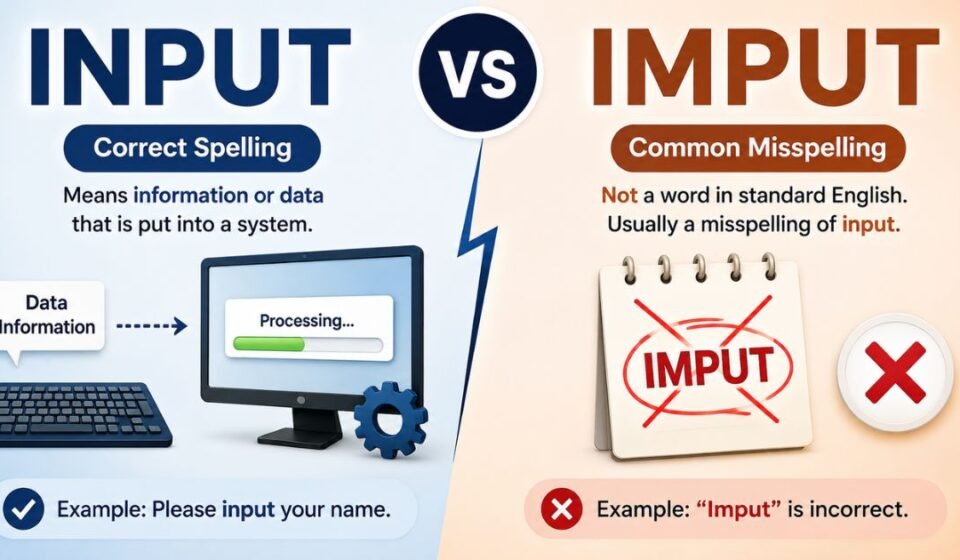
Here is the short answer. “Input” is correct. “Imput” is not a real word in English. It does not appear in any standard dictionary, and it has no accepted meaning of its own. Yet the mistake is so common that it deserves a real explanation, not just a quick correction.
This article will walk through why this mix-up happens, how the word “input” actually works in grammar, where it shows up in writing, and how you can stop making the mistake for good. By the end, you will understand this word better than most native speakers do.
Why Does Your Brain Keep Typing “Imput”?
The mistake is not random. It comes from how our mouths and brains handle sound patterns. When we say “input” out loud, especially at normal speaking speed, the “n” sound often shifts closer to an “m” sound. This happens because the next letter is “p,” and “p” is formed with closed lips, just like “m.” Your mouth naturally wants to shortcut the movement.
This kind of sound shift has a name in linguistics: assimilation. It happens all the time in spoken English, and it is completely normal. The problem starts when people write the word the way it sounds instead of the way it is spelled. Speech and spelling do not always match, and “input” is one of the clearest examples of that gap.
There is also a simple typing factor. On a keyboard, the letters M and N sit right next to each other. A fast typist under time pressure can easily hit the wrong key without noticing. Add autocorrect tools that sometimes miss this specific error, and the mistake spreads even further.
Here is a quick breakdown of the main causes:
| Cause | What Happens |
| Sound assimilation | The “n” sound blends toward “m” before the “p” sound |
| Keyboard proximity | M and N are next to each other on most keyboards |
| Muscle memory | People type words the way they say them |
| Autocorrect gaps | Some tools do not flag “input” as an error |
| Rushed writing | Speed increases the chance of small letter swaps |
Historical Evolution and Core Concepts
To really understand why “input” is spelled the way it is, it helps to look at where the word came from and how English builds words like it.
Etymology and Compound Word Formation
“Input” is a compound word. It comes from two older English pieces: “in” and “put.” Both parts have been part of English for a very long time, long before computers or business meetings existed. “In” shows direction or entry, and “put” means to place something somewhere. Put them together, and you get a word that literally means “to put in.”
This kind of word building is common in English. We do the same thing with words like “output,” “upload,” and “outcome.” Once you see the pattern, “input” stops looking like a strange spelling and starts looking like simple logic. There is no letter M anywhere in either root word, which is exactly why “imput” has no historical basis at all.
The word grew in popularity during the 19th and 20th centuries, first in economics and engineering, and later in computing. Each field borrowed the same basic idea: something goes in, gets processed, and something else comes out.
Grammatical Mechanics and Zero Derivation
“Input” is also a great example of something called zero derivation. This is when a word moves from one part of speech to another without changing its spelling at all. “Input” can be a noun (“Please give me your input”) or a verb (“Please input the data”). No extra letters, no suffix, nothing added.
This flexibility is one reason the word is so widely used. Writers do not need to learn a second version of the word for different sentence roles. The tradeoff is that people sometimes assume a word this flexible must have a flexible spelling too, which is part of why “input” keeps sneaking in.
How Input Functions in Real Contexts
Words do not exist in a vacuum. How “input” gets used changes a little depending on where you are writing or speaking.
Formal Academic and Professional Usage
In business, science, and academic writing, “input” is a workhorse word. It shows up in reports, research papers, meeting notes, and technical manuals. In these settings, precision matters, so getting the spelling right is not optional.
Common formal uses include:
- “We need stakeholder input before the final decision.”
- “The input data was cleaned before analysis.”
- “Employee input helped shape the new policy.”
In technical fields like computer science and engineering, “input” often pairs with “output” to describe a system. A calculator takes numeric input and produces a numeric output. A sensor takes physical input, like temperature, and produces a digital reading. This input-output pattern is one of the most basic ideas in both computing and systems thinking.
Casual Conversational Contexts
In everyday speech, “input” softens a bit. People use it to mean an opinion, a suggestion, or a small contribution to a group decision. You might hear it in a family conversation, a group chat, or a casual meeting.
Examples of casual use:
- “What’s your input on this restaurant choice?”
- “I just want everyone’s input before we book the trip.”
- “Thanks for the input, that really helped.”
Even in this relaxed setting, the spelling does not change. Casual tone affects word choice and sentence structure, but it never changes how a word is spelled.
The Nuance Trap: When Autocorrect Fails
Many people assume spellcheck will always save them. That is not true. Some autocorrect systems focus on catching nonsense words, but “input” sometimes slips through, especially in fast typing apps, chat tools, or older software. Voice-to-text tools can also cause trouble, since they transcribe the sound you make, not the correct spelling of the word.
This is why understanding the word matters more than relying on a tool. Technology helps, but it is not perfect, and this specific error is one it often misses.
Input and Imput in Literary and Technical History
Language history gives us useful proof of how “input” earned its place, and how “imput” never did.
Classic Literature and Early Usage
Early written English used “input” mostly in technical and economic writing rather than fiction. It described things like raw materials going into a production process, or effort going into a piece of work. Old economic texts often used phrases about labor input and capital input to describe how resources fed into a system.
As dictionaries and style guides formed over the centuries, “input” was recorded and standardized. “Input” never appeared in these historical records because it was never a recognized word. It is simply a spelling slip that has traveled forward through modern habits, not an old alternate spelling that fell out of fashion.
Modern Stylistic and Technical Usage

The word exploded in popularity with the rise of computing in the 20th century. Programmers needed a simple way to describe data entering a system, and “input” fit perfectly. From there, it spread into everyday tech language: input fields on forms, input devices like keyboards, and input errors in software.
Style guides used by publishers, universities, and news organizations all agree on one spelling. None of them list “input” as an accepted variant, informal or otherwise. This consistency across decades and industries is strong proof that “input” is the only correct form.
Synonyms and Distinguishing Input from Similar Terms
Knowing similar words helps you use “input” more precisely, and helps you spot when a different word might fit better.
Semantic Neighbors and Functional Alternatives
Here are common alternatives, along with how they differ:
| Word | Best Used When |
| Feedback | You want a reaction or evaluation of something already done |
| Suggestion | You want a new idea or recommendation |
| Contribution | You want to highlight someone’s added effort or value |
| Opinion | You want a personal viewpoint, not necessarily data |
| Data | You mean raw facts or numbers entering a system |
“Input” often overlaps with these words, but it carries a broader, more neutral tone. It can describe facts, opinions, effort, or raw data, depending on context. That flexibility is part of why it is used so often across so many fields.
Visualizing the Articulatory Difference
If you say “input” slowly and pay attention to your mouth, you will notice your lips barely touch the “n” sound. Now say “input” the way it is misspelled, and notice how your lips close firmly for a true “m” sound. This small physical difference is exactly why the ear can be fooled, even though the correct spelling keeps the letter N.
A simple way to test yourself out loud:
- Say the word slowly, one sound at a time: “in-put.”
- Notice that your tongue touches near your front teeth for the “n,” not your lips closing like an “m.”
- Speed the word up and see how easily it can blur, then remind yourself the spelling stays fixed.
Regional Variations: US vs UK
Good news here: this is one spelling issue that does not change across English dialects. American English and British English both spell the word “input,” with no regional exceptions.
| Region | Correct Spelling | Notes |
| United States | Input | Standard in all major US dictionaries |
| United Kingdom | Input | Standard in all major UK dictionaries |
| Australia/Canada | Input | Follows the same standard spelling |
Unlike words such as “colour” versus “color,” there is no accepted regional split here. “Imput” is incorrect everywhere English is spoken, in every dialect and every style guide.
Common Mistakes People Make

Beyond the basic “input” spelling error, a few related mistakes show up often. Knowing them helps you avoid a wider range of writing slips.
- Writing “imputed” instead of “input” or “inputted” as the past tense
- Confusing “input” with “impute,” which is a completely different word meaning to attribute blame or a quality to someone
- Using “input” and “feedback” as if they mean exactly the same thing in every situation
- Forgetting that “input” as a verb can stay the same in past tense in many style guides (“I input the data yesterday”)
- Overusing “input” in writing when a more specific word, like “suggestion” or “data,” would be clearer
That second point deserves extra attention. “Impute” is a real word, but it means something very different. It usually appears in sentences like, “Do not impute bad intentions to someone based on a mistake.” Mixing up “impute” and “input” can quietly change the meaning of a sentence.
Practical Tips and Field Notes
Once you understand where the confusion comes from, avoiding it becomes much easier. Here are some practical habits that help.
The Editor’s Field Note
Professional editors often catch this error by reading text out loud, slowly, word by word. This breaks the automatic sound-blending your brain does when reading fast. If you read “input” out loud syllable by syllable, “in” and “put,” the correct spelling becomes obvious again.
Another editor trick is to search your document for “input” before sending anything important, especially long reports or emails. It takes a few seconds and can save you from an easy-to-miss mistake.
Mnemonics and Memory Aids
A mnemonic is a small memory trick that helps a spelling stick. Try one of these:
- “Input” has “in,” just like “inside.” Something goes inside.
- Remember the two roots: “in” plus “put.” Nothing about the letter M belongs in either piece.
- Think of “input” like “insert”: both start with “in” and both describe something going into a space.
Repeating a mnemonic a few times when you learn a tricky word often makes the correct spelling automatic within a week or two.
Final Thoughts
“Input” is the only correct spelling, in every context, every region, and every level of formality. “Input” is a common mistake, not a valid alternative, and it comes mostly from how our mouths naturally shape sound before a “p.” Once you understand this sound pattern, the mistake becomes much easier to catch and correct.
The best way to lock in the correct spelling is simple repetition paired with awareness. Read the word slowly, remember its two honest building blocks, “in” and “put,” and double check your writing before you hit send. Small habits like these turn a common typing slip into a mistake you simply stop making.
Frequently Asked Question
Is “imput” ever correct in English?
No. “Input” is not a recognized word in any standard English dictionary, in any region.
Why do people spell “input” as “input”?
It usually happens because the “n” sound blends toward an “m” sound before the “p” sound when spoken quickly.
Is “input” a noun or a verb?
“Input” can be both. It works as a noun, like “give me your input,” and as a verb, like “input the data.”
What is the past tense of “input”?
Many style guides accept “input” as the past tense itself, though “inputted” is also used and accepted in informal writing.
Is “impute” the same word as “input”?
No. “Impute” means to attribute a quality or blame to someone, while “input” means something entering a system or process.

Mubeen is a passionate writer and content creator who enjoys sharing useful, engaging, and easy-to-understand information. With a focus on well-researched and reader-friendly content, Mubeen aims to help readers discover valuable insights and reliable information.