

Ever stared at a blank page while snow fell outside your window? You could picture the scene clearly. The words just wouldn’t show up.That’s a common writing problem. “White” feels flat, and “cold” says nothing new.
A snow simile fixes it fast. It compares snow to something familiar using like or as, such as “as white as snow” or “like a blanket of snow.” Below you’ll find 17 of them, each with a real example, plus writing tips to make your descriptions stick.
Quick Definition of a Simile

A simile is a figure of speech that compares two different things. It links them with the word like or as. “Her smile was as bright as snow in sunlight” is a clean example.
Why does it work? Readers already know how snow looks, feels, and sounds. You borrow that memory, so your vivid descriptions need fewer words.
Don’t mix it up with a metaphor. A metaphor says one thing is another. A simile only says it’s like another, which keeps the comparison softer and easier to control.
Full List of Snow Similes
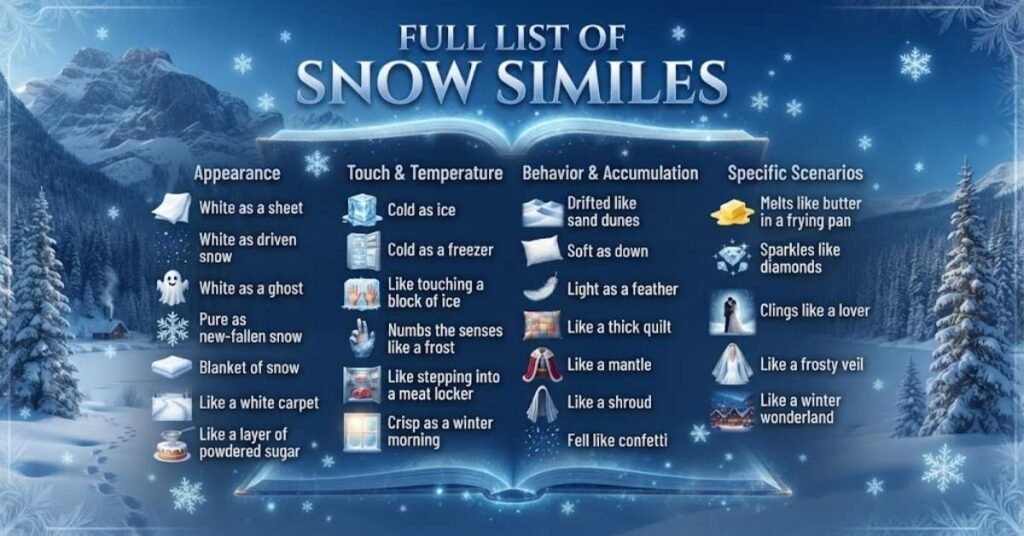
Here are 17 snow similes you can use right now. Each one comes with a short example and a tip on where it fits best.
Copy the ones you love, then bend them into your own voice. A borrowed line works harder when you attach it to something specific.
As white as snow
This is the classic white color comparison. Because everyone has heard it, pair it with something unexpected. “Grandma’s tablecloth was as white as snow, without a single crease.”
It fits a dress, a scarf, or a fresh notebook page. Add one small detail, like that crease, and it stops sounding tired.
As cold as snow
Use this for coldness you can feel in the body. “His hands were as cold as snow after the long walk home.”
It also works for emotions. “Her reply was as cold as snow” tells us the feelings had gone missing without one angry word.
As soft as snow
This one sells touch and softness. “The pillow was as soft as snow, and I sank right in.”
Stick to fresh snow here. Packed or icy snow feels hard, so readers will notice a mismatch. It suits a feather, a blanket, or a baby’s cheek.
As pure as snow
Here snow stands for purity and innocence. “Her intentions were as pure as snow, even when nobody believed her.”
It suits a child’s heart or an honest character. Back it with an action, though, or it can sound preachy.
Like a blanket of snow
This is perfect for atmosphere. “Silence settled over the village like a blanket of snow.”
It covers literal snow-covered ground and abstract things like calm or grief. Try it on a field, a room, or a mood.
As quiet as falling snow
Falling snow barely makes a sound. “He crept down the hall, as quiet as falling snow.”
That makes it great for steps, suspense, and gentle scenes. Readers hear the hush without you writing “silent” ten times.
Like sparkling snow
Now we’re in sparkling, glittering, and shiny territory. “Her eyes lit up like sparkling snow under the streetlamp.”
Use it for joy, a snowy night, or anything close to diamonds. It carries light better than plain “bright” does.
As light as snowflakes
This one captures lightness and delicate movement. “The dancer landed as light as snowflakes.”
It also works for relief. “After the exam, my worries felt as light as snowflakes.”
Like frozen snow
Not every snow simile is warm. Frozen snow is stiff and lifeless. “His smile sat on his face like frozen snow.”
Use it for fear, a fake expression, or a character who’s shut down. It shows readers that snow has a darker side.
As gentle as falling snow
“Her voice was as gentle as falling snow when she said goodnight.” That’s gentleness and calmness in one line.
It’s a strong pick for kind characters, a soft smile, or even a light wind.
Like fresh snow
Fresh snow means a new beginning. “The blank page looked like fresh snow, and I was afraid to step on it.”
Use it for first days, clean slates, or unwritten ideas. It pairs well with memories of starting over.
As bright as snow in sunlight
Snow in sunlight can make you squint. “The mountain peaks were as bright as snow in sunlight against the clear sky.”
It fits hope, brightness, and big snowy mountains views. Just don’t use it at night, or the picture falls apart.
Like melting snow
This one is about change and fading. “Her anger faded like melting snow.”
Melting snow also shows disappearance, stress leaving, or spring arriving. It’s gentle, but it hints that nothing lasts.
As clean as snow
Think spotless and smooth. “After two hours of scrubbing, the kitchen was as clean as snow.”
It can describe honesty too. “His record was as clean as snow.” Same comparison, two very different jobs.
Like drifting snow
Drifting snow moves slowly, pushed along by wind. “Rumors passed through the town like drifting snow.”
Use it for slow spread, wandering thoughts, or clouds on a lazy day. Movement is its strength.
As silent as snow
Quiet is soft. Silent is total. “The room was as silent as snow after the argument.”
Save this for moments when nothing is left to say. It hits harder than “as quiet as falling snow” because the silence feels final.
Like untouched snow
Picture a snowy field before the first footprint. “The lake lay like untouched snow, waiting for someone to cross.”
It’s ideal for possibility and peaceful scenes. It also hints that something is about to change, which pulls readers forward.
Transform Your Writing: Creative Ways to Use Snow Similes
Snow similes aren’t only for descriptive writing. They can set the mood, shape a character, or express feelings without spelling them out.
Let’s look at four writing formats and how each one uses snow imagery differently.
In Poems
Poetry loves short, sharp images. A line like “my grief lay still as untouched snow” says a lot in seven words.
Keep your line breaks tight. Let the simile sit at the end of a line so it lingers.
In Stories
In stories, snow similes can create atmosphere and reveal characters at the same time. “She entered the meeting as cold as snow, and everyone stopped talking.”
Try one per scene. That keeps your storytelling smooth and makes each comparison count.
In Songs
Songs need images listeners can picture on the first hearing. “Light as snowflakes” works because it’s instantly clear.
Rhythm matters too. Short similes fit a melody more easily than a long, tangled one.
In Essays
In essays, a simile should clarify, not decorate. “A clear thesis is like fresh snow: one blot and readers see it.”
Use them sparingly, ideally in the intro or conclusion. One well placed comparison beats five forced ones.
What Snow Stands For: Symbols Behind the Similes
Snow carries meaning beyond its color. It’s a symbol of purity, innocence, beauty, and peace. It’s also a symbol of coldness, silence, and softness.
Snow signals change and disappearance too. A snowfall transforms a street overnight, then melts and leaves nothing behind. Writers use that to show memories fading or dreams slipping away.
Knowing these symbols helps you choose better. “As pure as snow” suits love or honesty. “Like frozen snow” fits fear or anger. Match the symbol to the feeling and your emotional writing lands harder.
How to Pick the Right Snow Simile
Ask yourself three quick questions. What feeling do I want? Which sense do I need: sight, touch, or sound? What am I comparing the snow to?
Then read the sentence out loud. If it sounds forced, swap it.
Here’s a quick cheat sheet:
| Mood or goal | Snow simile | Works well with |
| Purity | As pure as snow | Intentions, a child’s heart |
| Calm | Like a blanket of snow | Villages, rooms |
| Suspense | As quiet as falling snow | Steps, hallways |
| Coldness | As cold as snow | Hands, replies |
| New start | Like fresh snow | Pages, notebooks |
| Fading | Like melting snow | Anger, worries |
Common Mistakes to Avoid
The biggest one is overuse. Avoiding overuse of similes keeps your work sharp. If every sentence has a comparison, none of them stand out.
Another trap is cliché. “As white as snow” is fine once, but add a detail to make it yours. Also check that the picture matches. Soft snow won’t be stiff in the same sentence, unless that’s the point.
Finally, don’t explain a simile after you write it. Trust your reader. If the image works, one line is enough.
Conclusion
Snow similes turn plain descriptions into memorable writing. Pick one that fits your mood, tie it to a specific object, and keep it short.
Which one is your favorite? Drop it in the comments, or share a line you wrote yourself. Send this list to a friend who’s stuck on a poem, and come back for more writing tips.
FAQs
What is a snow simile?
A snow simile compares snow to something else using like or as. “As white as snow” is the best known example. It helps readers picture a scene quickly.
Why are snow similes popular in writing?
Everyone knows snow. It looks, feels, and sounds distinct, so one comparison can carry imagery, mood, and emotion at once. It also brings strong symbols like purity and peace.
Can snow similes describe emotions?
Yes. “Cold as snow” can show distance or anger. “Like melting snow” can show relief or fading fear. “As pure as snow” fits love or innocence.
Are snow similes useful in essays?
They are, in small doses. One clear comparison in an intro or conclusion adds clarity and personality. Too many make an essay feel like a poem.
What is the most common snow simile?
“As white as snow” is the most common. It’s so familiar that many writers add a fresh detail to make it their own.

Mubeen is a passionate writer and content creator who enjoys sharing useful, engaging, and easy-to-understand information. With a focus on well-researched and reader-friendly content, Mubeen aims to help readers discover valuable insights and reliable information.