
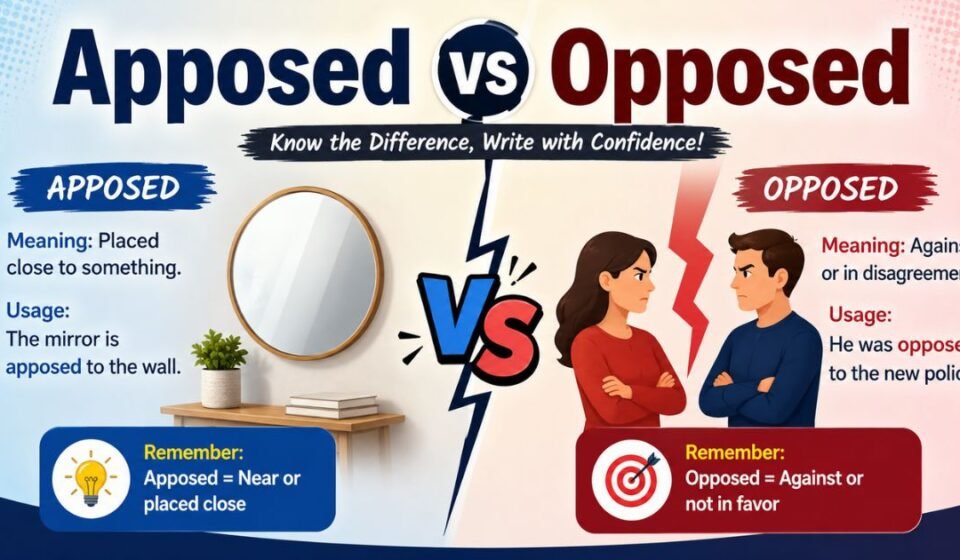
Have you ever paused while writing and wondered if you should use “apposed” or “opposed”? You are not alone. These two words look almost the same on paper, but they mean very different things. Mixing them up can confuse your reader or even change the meaning of your sentence completely.
In this guide, we will break down both words in simple terms. You will learn what each word means, how to use them correctly, and how to avoid common mistakes. By the end, you will never second-guess yourself again.
The Grammar Rule: Understanding Apposed and Opposed
Let’s start with the basics. “Apposed” and “opposed” are both past tense verbs, but they come from completely different root words with different meanings.
Apposed comes from the verb “appose,” which means to place things side by side or close together. It is often used in science, medicine, and anatomy. For example, doctors might say that two bone surfaces are apposed when they sit next to each other.
Opposed comes from the verb “oppose,” which means to disagree with, resist, or stand against something. This is the word most people already know. It shows up in everyday conversations, news articles, and debates.
Here is a simple table to help you see the difference at a glance:
| Word | Root Verb | Meaning | Common Use |
| Apposed | Appose | Placed side by side | Science, medicine, formal writing |
| Opposed | Oppose | Against or disagreeing with | Everyday speech, politics, debates |
Notice that “apposed” is a positive, neutral word. It simply describes position, not conflict. “Opposed,” on the other hand, often carries a negative or confrontational tone, since it means resistance or disagreement.
How to Use Apposed vs Opposed Correctly
Using these words correctly comes down to understanding the context of your sentence. Ask yourself: am I talking about placement, or am I talking about disagreement?
If you are describing something placed next to or touching another thing, use “apposed.” If you are describing resistance, disagreement, or being against something, use “opposed.”
Here are some example sentences to make this clear:
- The two cell walls were apposed during the experiment.
- The surgeon carefully apposed the skin edges before stitching.
- Many residents opposed the new construction project.
- She strongly opposed the plan from the very beginning.
- The two magnets were apposed but not touching.
A quick way to check yourself is to try replacing the word with “placed next to” or “against.” If “placed next to” fits, use “apposed.” If “against” fits better, use “opposed.”
| Sentence Type | Correct Word | Example |
| Describing position | Apposed | The plates were apposed on the table. |
| Describing disagreement | Opposed | He opposed the idea completely. |
Common Mistakes with Apposed vs Opposed
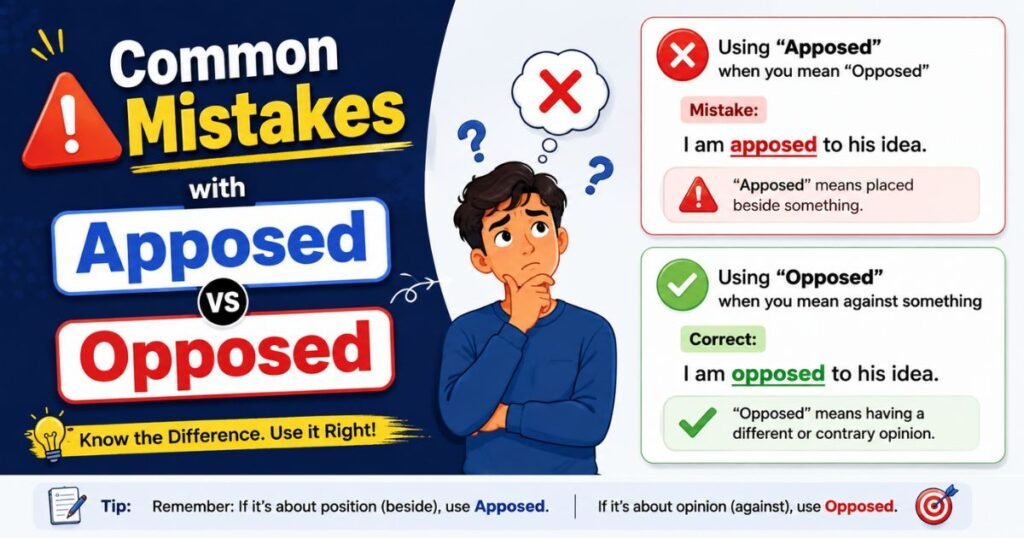
The biggest mistake people make is using “opposed” when they actually mean “apposed,” simply because “opposed” is the more familiar word. Since we hear “opposed” far more often in daily life, our brains default to it, even when it is wrong.
Another common error happens in medical and scientific writing. Students and even professionals sometimes swap the two words by accident, which can change the meaning of a sentence in a serious way. Saying tissues were “opposed” instead of “apposed” suggests conflict, not closeness, which is misleading.
Here is a quick list of mistakes to avoid:
- Writing “opposed” when describing two surfaces touching (should be “apposed”)
- Using “apposed” in a debate or argument context (should be “opposed”)
- Confusing the noun forms: “apposition” versus “opposition”
- Forgetting that “opposed” often needs a preposition, like “opposed to”
- Assuming both words are interchangeable, when they are not
It also helps to notice the tone of each word. “Apposed” has a calm, neutral, almost positive feel since it describes cooperation in placement. “Opposed” carries a more negative or tense feeling, since it involves conflict or resistance. Keeping this emotional tone in mind can guide you toward the right word, even when you are unsure of the technical rule.
How to Remember the Difference

Memory tricks make grammar rules stick. Here are a few simple ways to lock in the difference between these two words.
First, think of the letter “A” in “apposed” as standing for “Alongside.” Both words start with the letter A, and both ideas involve things being close together, side by side.
Second, think of “opposed” as containing the word “oppose,” which most people already know means to be against something. If you can spot “oppose” inside “opposed,” you will remember its negative, confrontational meaning right away.
Here is a short memory list:
- Apposed = Alongside (positive, neutral placement)
- Opposed = Oppose (negative, against something)
- If in doubt, ask: touching or fighting?
- Apposed shows up mostly in science and medicine
- Opposed shows up mostly in daily conversation and debate
Repeating these tricks a few times will help the difference become automatic, so you won’t need to stop and think every time you write.
Visualizing the Decision Process
Sometimes a simple mental flowchart makes the choice easier than any rule ever could. Picture two boxes in your mind, one for placement and one for conflict.
Also Read This:A Day Well Spent
Step one: ask what your sentence is really describing. Is it about two things sitting close together, or is it about disagreement and resistance?
Step two: if the answer is placement, go with “apposed.” If the answer is disagreement, go with “opposed.”
Step three: double-check by reading the sentence out loud. If it sounds like a science or anatomy description, “apposed” usually fits. If it sounds like an opinion, argument, or political statement, “opposed” is almost always correct.
| Step | Question | Answer Leads To |
| 1 | Is this about position? | Apposed |
| 2 | Is this about disagreement? | Opposed |
| 3 | Does it sound scientific? | Apposed |
| 4 | Does it sound like an opinion? | Opposed |
This simple three-step process works for almost every sentence you will ever write, whether it is a school essay, a medical report, or a casual email.
Word Origins: Where These Terms Come From
Understanding where words come from often makes them easier to remember. Both “apposed” and “opposed” trace back to Latin roots, but their paths are different.
“Apposed” comes from the Latin word “apponere,” which means “to place near.” The prefix “ad-” means “to” or “toward,” and “ponere” means “to place.” Put them together, and you get the idea of placing something toward or next to another thing.
“Opposed” comes from the Latin word “opponere,” which means “to set against.” The prefix “ob-” means “against,” and again “ponere” means “to place.” So instead of placing something near, you are placing it against something else, which naturally creates the idea of conflict.
| Word | Latin Root | Prefix Meaning | Root Meaning | Combined Meaning |
| Apposed | Apponere | Toward | To place | Placed near |
| Opposed | Opponere | Against | To place | Placed against |
This tiny difference in prefixes, “ad-” versus “ob-,” explains why one word feels neutral and the other feels negative. Once you see the roots side by side, the meanings almost explain themselves.
Synonyms and Alternatives
If you are still unsure which word to use, sometimes it helps to think of synonyms instead. Choosing a simpler alternative can also make your writing clearer for readers.
For “opposed,” you could use:
- Placed beside
- Positioned next to
- Adjacent to
- Touching
- Joined closely
For “opposed,” you could use:
- Against
- Resisted
- Disagreed with
- Objected to
- Fought against
Here is a quick comparison table showing the tone of each set of synonyms:
| Apposed Synonyms (Neutral/Positive) | Opposed Synonyms (Negative) |
| Adjacent to | Against |
| Placed beside | Resisted |
| Positioned next to | Objected to |
| Touching | Fought against |
| Joined closely | Disagreed with |
Using these alternatives can be a safe backup plan whenever you are not one hundred percent sure which of the two original words fits best.
When to Use Each Term
Let’s put everything together with clear, practical guidance on when to use each word in real writing situations.
Use “opposed” when:
- You are writing in a medical, scientific, or anatomical context
- You want to describe two surfaces or objects placed close together
- There is no idea of conflict or disagreement involved
- You are describing a calm, neutral, or even positive physical arrangement
Use “opposed” when:
- You are describing disagreement, resistance, or conflict
- You are writing about opinions, politics, or debates
- You want to show that someone is against an idea, plan, or person
- The tone of your sentence is negative or confrontational
Here is one final table to summarize everything you have learned:
| Feature | Apposed | Opposed |
| Meaning | Placed side by side | Against or resisting |
| Tone | Neutral to positive | Negative |
| Common field | Science, medicine | Everyday speech, politics |
| Root word | Appose | Oppose |
| Example | The tissues were apposed | The group opposed the law |
Final Thoughts
Learning the difference between “apposed” and “opposed” does not have to be complicated. Once you remember that “apposed” is about placement and “opposed” is about disagreement, the confusion disappears. The Latin roots, the memory tricks, and the simple three-step decision process all point to the same conclusion: think about whether your sentence describes closeness or conflict.
Good writing depends on small details like this one. Choosing the right word makes your message clearer and more professional, whether you are writing a school paper, a medical report, or a simple email. Keep this guide handy, and you will never mix up “apposed” and “opposed” again.

Mubeen is a passionate writer and content creator who enjoys sharing useful, engaging, and easy-to-understand information. With a focus on well-researched and reader-friendly content, Mubeen aims to help readers discover valuable insights and reliable information.