
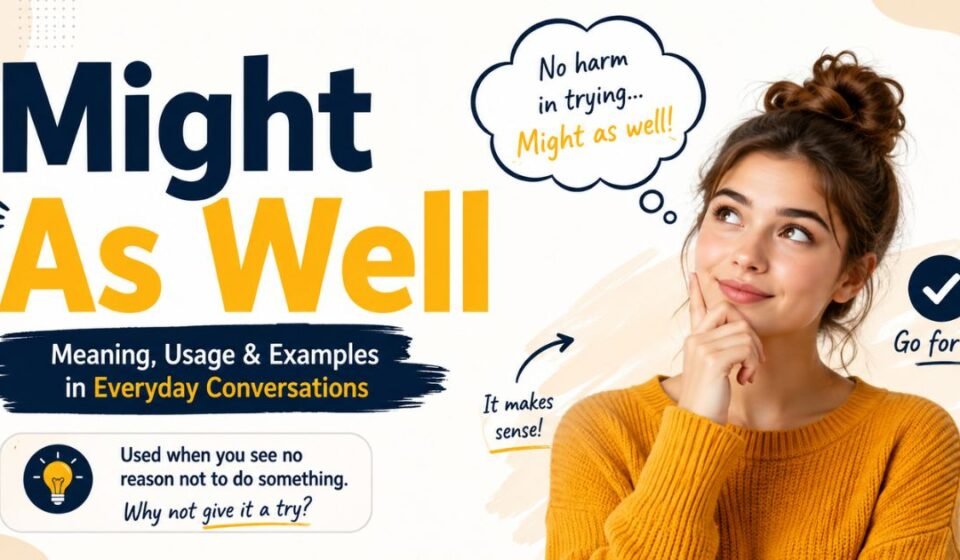
English learners and even native speakers often get confused about “might as well,” “mine as well,” and “mind as well.” These three phrases sound almost the same when spoken quickly. But only one of them is grammatically correct in standard English. The other two are common mistakes that show up in casual writing, texting, and everyday speech.
This guide breaks down each phrase in plain, simple terms. You will learn what each one means, how to use it correctly, and why the wrong versions still show up so often. By the end, you will never mix these three up again.
Contextual Examples
The best way to understand these phrases is to see them used in real sentences. Once you see them side by side, the differences become much clearer. Below are examples for each version, along with notes on when each one is actually correct.
Standard Idiom: Might As Well
“Might as well” is the only version accepted in standard grammar. It means there is no strong reason not to do something, so you decide to go ahead with it. For example: “It’s raining anyway, so we might as well stay home.” This phrase always uses the modal verb “might,” never “mind” or “mine.”
Possessive: Mine As Well (Contextualised)
“Mine as well” is not an idiom at all. It is a possessive phrase that only makes sense in a very specific context, such as comparing ownership. For example: “Your book is on the shelf, and mine as well.” Here, “mine” means “my book,” and “as well” means “also.” This is a completely different structure from the idiom.
Nonstandard Variant: Mind As Well
“Mind as well” is a common misspelling of “might as well.” It happens because the two phrases sound similar when spoken fast, especially in casual accents. Some people write “mind as well” without realising it is incorrect. It has become common in text messages and social media, but it is not accepted in formal writing.
Embedded Question Forms
These phrases can also appear inside questions, which can confuse learners even more. For example: “Do you think we might as well leave now?” or “I wonder if we might as well try the other route.” The structure stays the same even when wrapped inside a longer question.
Tag Along: Might As Well + Result Clause
Often, “might as well” is followed by a result or consequence. This shows what will happen because there is no reason to avoid it. For example: “We might as well finish the project today, since we have the time.” The result clause adds context and makes the sentence more natural.
| Phrase | Type | Correct Usage | Example |
| Might as well | Idiom | Yes, standard | “We might as well leave now.” |
| Mine as well | Possessive phrase | Only in specific context | “This is my pen, and that one is mine as well.” |
| Mind as well | Misspelling | No, incorrect | Should be “might as well” |
Common Mistakes
Even confident writers slip up with these phrases. Below are the most common mistakes people make, along with simple explanations of why they happen.
Mistake: Replacing Might With Mind
This is the most frequent error. Writers swap “might” for “mind” because the words sound alike in fast speech. But “mind” is a noun or verb related to thinking, not a modal verb. It never belongs in this idiom.
Mistake: Using Mine As Well Without Clear Antecedent
Some writers use “mine as well” but forget to make clear what “mine” refers to. Without a clear subject before it, the sentence becomes confusing. Readers are left wondering what the writer actually owns or means.
Mistake: Confusing Meaning With Merely Adding “As Well”
“As well” on its own simply means “also.” Some writers think adding “as well” to any sentence creates the idiom. But the idiom only works with “might,” not with random subjects or pronouns placed before it.
Mistake: Punctuation With Elliptical Replies
In short replies, punctuation matters. “Might as well.” used alone as a reply needs a period or exclamation mark, not a trailing comma. Poor punctuation can make short replies look like unfinished thoughts.
Mistake: Overusing Idiom Without Consequence
The idiom “might as well” naturally implies a reason or result. Using it repeatedly without giving any context weakens your writing. Readers expect some explanation for why there is “no reason not to.”
Quick checklist to avoid these mistakes:
- Always use “might,” never “mind,” in the idiom
- Make sure “mine” has a clear subject before using it
- Do not confuse “as well” alone with the full idiom
- Punctuate short replies properly
- Give a reason or result when using “might as well”
American vs British English Differences

Both American and British English use “might as well” the same basic way. But there are small regional differences worth knowing, especially for writers who want to sound natural in either dialect.
Shared Core Usage
In both American and British English, “might as well” carries the same meaning. It shows a lack of a strong reason to avoid an action. This core usage has not changed much across either dialect over time.
Regional Variants and Informal Speech
British informal speech sometimes uses “may as well” instead of “might as well.” Both are accepted, but “may as well” sounds slightly more common in the UK. American English leans more toward “might as well” in almost every situation.
Also Read This:Input vs Imput
Preference For Might vs May
Americans tend to prefer “might” in casual and formal writing alike. British speakers use “may” more freely, especially in polite or softer suggestions. Neither version is wrong, but the choice can make writing feel more natural to a specific audience.
Teaching Note
Language teachers should point out that “mind as well” is not a regional variant. It is simply an error, no matter which dialect a student is learning. Teachers should treat it as a spelling mistake, not a dialect choice.
| Feature | American English | British English |
| Common form | Might as well | May as well / Might as well |
| Formality | Used in both formal and casual writing | Slightly more casual with “may as well” |
| Mistake rate | Common in texting | Common in casual speech |
Idiomatic Expressions
Beyond the basic form, “might as well” appears in several idiomatic patterns. Understanding these patterns helps you use the phrase more naturally in conversation and writing.
Might As Well + Infinitive Result
This pattern pairs the idiom with an infinitive verb to show the next logical step. For example: “We might as well try to finish early.” The infinitive verb shows what action follows from the lack of a better option.
Mine As Well as Ellipsis
In short replies, “mine as well” can appear as an ellipsis, cutting out repeated words. For example: “Is that your coat? Mine as well.” Here, the full sentence would be “That is mine as well,” but the speaker drops the earlier part.
Mind As Well in Dialogue
Writers sometimes use “mind as well” on purpose in dialogue to show a character’s accent or speech habit. This is a stylistic choice, not a grammar rule. It should only appear in quoted speech, never in narration or formal text.
Idiom Variants With Conditionals
“Might as well” often appears with conditional clauses. For example: “If it’s free, we might as well take it.” The conditional clause explains the reason behind the decision, making the idiom feel more complete.
Practical Tips

Here are ten practical tips to help you use these phrases correctly every time you write or speak.
Tip 1: Use a Simple Substitution Test
Try replacing the phrase with “there is no real reason not to.” If the sentence still makes sense, “might as well” is the correct choice.
Tip 2: Keep Modal Grammar Straight
Remember that “might” is a modal verb, just like “could” or “should.” Modal verbs never change to nouns like “mind” in this structure.
Tip 3: Avoid Using Mine As Well Without Context
Only use “mine as well” when there is a clear object or subject before it. Otherwise, readers will not understand what you own or mean.
Tip 4: Mark Dialogue For Nonstandard Speech
If you use “mind as well” in fiction to show a character’s voice, keep it inside quotation marks. Never use it in narration.
Tip 5: Teach Learners the Difference With Minimal Pairs
Show learners both phrases side by side, such as “might as well” versus “mind as well.” Minimal pairs make the difference easier to hear and remember.
Tip 6: Use Commas And Ellipses Properly
When shortening a reply, make sure your punctuation still makes the sentence clear. A dropped comma or missing period can confuse readers.
Tip 7: Don’t Overuse Idioms
Idioms lose their power when used too often. Save “might as well” for moments when it truly fits the meaning of your sentence.
Tip 8: Watch Register
“Might as well” fits both casual and semi-formal writing. Avoid it in strict formal documents like legal contracts or academic papers.
Tip 9: Proofread for Common Typos
Spell checkers often miss “mind as well” because “mind” is a real word. Always proofread by reading the sentence out loud.
Tip 10: Teach Consequence Clauses
Encourage writers to always follow “might as well” with a clear reason or result. This makes sentences stronger and easier to understand.
Summary of tips:
- Test the sentence with a substitution phrase
- Remember “might” is a modal verb
- Use “mine as well” only with clear context
- Keep “mind as well” inside dialogue only
- Teach with minimal pairs
- Punctuate short replies carefully
- Do not overuse the idiom
- Match the phrase to the right register
- Proofread out loud
- Always add a reason or result
Final Thoughts
Getting these phrases right is not about memorising rules for the sake of it. It is about writing clearly so your reader never has to guess what you mean. A small mix up like “mind as well” instead of “might as well” can make your writing look careless, even if your ideas are strong.
The good news is that this is an easy fix once you know what to look for. Practice the substitution test, watch out for the common mistakes listed above, and read your sentences out loud before you publish them. With a little practice, choosing the right phrase will become automatic.

Mubeen is a passionate writer and content creator who enjoys sharing useful, engaging, and easy-to-understand information. With a focus on well-researched and reader-friendly content, Mubeen aims to help readers discover valuable insights and reliable information.