
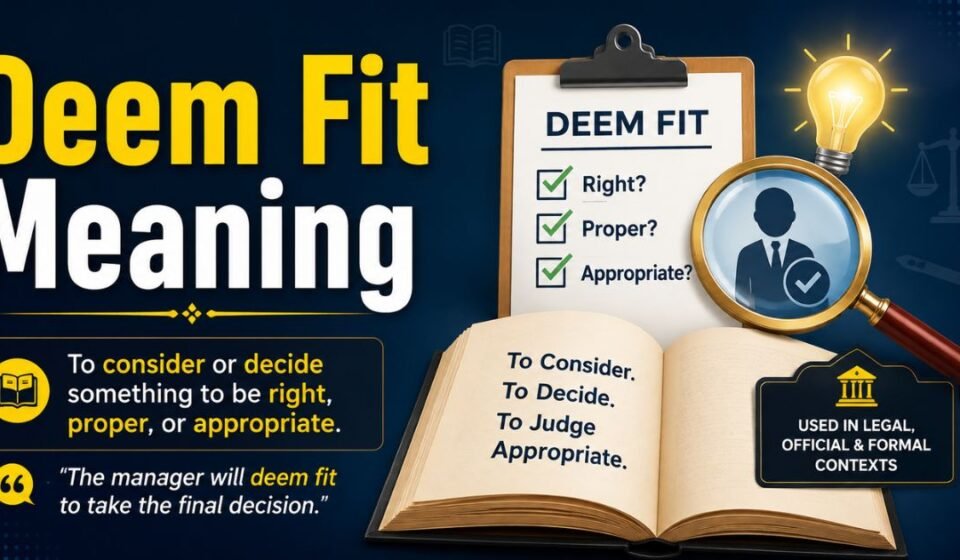
The phrase “deem fit” shows up in contracts, official letters, and formal speech. Many people read it and understand it, but few can explain it clearly. It carries a formal tone, and it often signals that someone holds the power to make a final decision. Because of this, the phrase appears again and again in legal documents, workplace policies, and government notices.
This guide breaks down the phrase in plain language. You will learn what it means, where it came from, how to use it correctly, and how to avoid common mistakes. By the end, you will be able to use “deem fit” with full confidence, in writing and in speech.
Understanding The Core Concepts Of Deem Fit
“Deem fit” is a formal phrase. It means to judge something as suitable, correct, or appropriate. When someone says they will act “as they deem fit,” they mean they will choose the action they think is best.
This phrase gives a person the power to decide. It does not list exact rules. Instead, it leaves room for judgment. That is why you see it so often in legal papers, business rules, and official announcements.
Definitions And Meanings Of Deem Fit
At its simplest, “deem fit” means “consider appropriate” or “judge as suitable.” The word “deem” means to form an opinion or judgment about something. The word “fit” means suitable, right, or proper for the situation.
Put together, the phrase gives someone the freedom to decide what action or outcome is correct, based on their own judgment. It does not need proof or evidence. It simply reflects a personal or official decision.
Here is a simple table to show the meaning clearly:
| Word | Meaning |
| Deem | To judge, consider, or believe |
| Fit | Suitable, proper, or correct |
| Deem fit | To judge something as suitable or correct |
Etymology And Evolution
The word “deem” comes from Old English “deman,” which meant to judge or to give a verdict. It has roots in old Germanic languages too. Courts and judges used this word long before modern law existed.
“Fit” comes from Middle English and relates to being suitable or well matched for a purpose. Over time, English speakers combined these two words into a set phrase. Lawyers and officials picked it up because it sounded formal and carried authority.
Today, the phrase survives mostly in legal writing, official rules, and formal speech. It rarely appears in casual conversation.
Grammatical Function And Mechanics
“Deem fit” usually works as a verb phrase followed by an infinitive or a noun clause. It often appears in sentences like “as the manager may deem fit” or “the board shall act as it deems fit.”
The subject (a person or group) is followed by a form of “deem,” then the word “fit.” Sometimes a “to” verb follows, such as “deem fit to proceed.” Other times, “fit” stands alone as the final word in the clause.
Key grammar points to remember:
- “Deem” changes form based on tense: deem, deems, deemed, deeming.
- “Fit” usually stays the same, since it acts as an adjective here.
- The phrase often follows words like “as,” “may,” or “shall.”
Contextual Examples
Seeing the phrase in real sentences helps make the meaning clear. Below are examples from different settings.
Standard Usage Of Deem Fit
- “The committee will take action as it deems fit.”
- “The teacher may grade the assignment as she deems fit.”
- “Management reserves the right to change the policy as it deems fit.”
Alternative Usage Or Nuance
Sometimes “deem fit” appears with a slight shift in meaning, closer to “decide is proper” rather than just “consider suitable.” For example: “The judge deemed it fit to dismiss the case.” Here, the phrase carries a stronger sense of formal decision, almost like a ruling.
Professional And Everyday Contexts
In business, “deem fit” often appears in employee handbooks and legal contracts. In government, it appears in laws and public notices. In everyday speech, people rarely say “deem fit.” Instead, they say “however I think is best” or “in whatever way I choose.”
Literary Usage And Cultural Impact Of Deem Fit

Even though “deem fit” sounds formal, it has left a mark on literature and culture. Writers use it to show authority, power, or old-fashioned speech patterns.
The phrase adds weight to a sentence. It suggests that someone holds the power to make a final call, without needing to explain their reasoning.
Famous Examples In Literature
Classic novels, legal dramas, and historical texts often use “deem fit” to show a character in a position of power. Judges, kings, and officials in fiction often “act as they deem fit,” which signals their authority over others.
Also Read This:Might As Well
This kind of language also appears in old speeches and historical documents, where formal tone mattered a great deal. Writers today sometimes borrow this style to create a serious or old-world feel in their stories.
Why The Phrase Resonates
People respond to “deem fit” because it sounds confident and final. It suggests control and wisdom. When a character or a document uses this phrase, it signals trust in that person’s judgment.
This is part of why the phrase survives in modern legal and business writing. It gives decision-makers flexibility without forcing them to spell out every possible situation in advance.
Synonyms, Antonyms, And Related Concepts
Knowing similar words helps you understand “deem fit” even better. It also helps you choose the right word for the right situation.
Close Synonyms And Distinctions
Here are some words and phrases close in meaning to “deem fit,” along with small differences in tone or use.
| Synonym | Difference In Use |
| Consider appropriate | Slightly less formal, used in everyday writing |
| See fit | Very close in meaning, often interchangeable |
| Think proper | Simpler and more casual |
| Judge suitable | More neutral, used in reports and reviews |
| Decide as best | Focuses more on decision than judgment |
Antonyms, or opposite ideas, include phrases like “deem unsuitable,” “consider improper,” or “judge as wrong.” These show the opposite judgment, that something is not correct or acceptable.
Regional Differences (US vs. UK) And Usage
Both American and British English use “deem fit,” but slight differences exist. British legal writing uses it more often, especially in government documents and official notices. American legal writing sometimes prefers “as deemed appropriate” or “at their sole discretion.”
Here is a quick comparison:
- UK usage: Common in acts of parliament, court rulings, and formal notices.
- US usage: Common in contracts, employee handbooks, and corporate policies.
- Shared usage: Both use “see fit” as a close, informal cousin of “deem fit.”
How Minds Process Deem Fit

Language experts study how readers understand formal phrases like this one. Understanding this helps writers use the phrase more effectively.
Etymological Dive
Because “deem” has roots in judgment and law, our brains often connect this phrase with authority. When we read “deem fit,” we unconsciously expect a decision-maker, a rule, or an official tone. This mental link makes the phrase feel serious, even in casual writing.
This explains why writers use “deem fit” to add weight to a sentence. Readers instantly sense formality and structure, even if they cannot explain why.
Variation And Nuance
Not every use of “deem fit” carries the same weight. In a strict legal document, it may carry binding power. In a casual email, it might just mean “however you prefer.” Context always shapes the emotional weight of the phrase.
Readers pick up on small clues, like sentence structure and surrounding words, to judge how serious the phrase really is.
The Error Log: Common Mistakes And Corrections
Many writers misuse “deem fit” without realizing it. Below are the most common mistakes, along with corrections.
| Mistake | Correction |
| “As they deem it fit” | “As they deem fit” (drop the extra “it”) |
| “Deem it as fit” | “Deem fit” or “deem it fit” |
| “Deemed to be fit” (in legal contexts) | Usually should be “deemed fit” |
| Using “deem fit” as a noun | “Deem fit” is a verb phrase, not a noun |
Breakdown For The Top Two Errors
Error 1: Adding unnecessary words. Many people write “as they deem it to be fit,” which sounds bulky. The cleaner and more natural phrasing is “as they deem fit.” Formal writing values short, clear phrasing, so trimming extra words always helps.
Error 2: Confusing “deem” with “seem.” Since both words sound similar, writers sometimes swap them by mistake, especially in fast typing or speech-to-text tools. “Deem” means to judge, while “seem” means to appear. Always double-check this before submitting formal documents.
Practical Tips And Field Notes
Using “deem fit” correctly takes a little practice. Below are useful tips to help you apply it naturally in your own writing.
- Use “deem fit” only in formal or semi-formal writing.
- Avoid using it in casual conversations or texts.
- Pair it with clear subjects, such as “the board,” “the manager,” or “the court.”
- Keep the sentence short and direct for the best formal tone.
- Do not add unnecessary words like “as” twice in one sentence.
Field Note From Experience
Professional writers often say the phrase works best in short, direct sentences. For example: “The director may act as she deems fit” reads better than a long, wordy version with extra clauses. Simplicity keeps the formal tone strong and clear.
Mnemonics And Memory Aids For Deem Fit
To remember the meaning, think of “deem” as a judge’s gavel and “fit” as a puzzle piece falling into place. Together, they mean “judge what fits best.”
Another simple trick: replace “deem fit” with “think is right” in your head while reading. If the sentence still makes sense, you are using it correctly.
How To Draft Clear Sentences Using Deem Fit
When writing your own sentences, follow this simple structure:
- Start with the subject (a person, group, or authority).
- Add a form of “deem” that matches the tense.
- Follow with “fit,” and an optional verb if needed.
Example structure: “The company may act as it deems fit to protect its interests.”
This structure keeps your sentence formal, clear, and grammatically correct every time.
Final Thoughts
“Deem fit” is a small phrase with a big role in formal English. It gives people the power to decide what is right, without needing to explain every detail. This makes it a useful tool in legal writing, business rules, and official communication.
Once you understand its meaning, grammar, and common mistakes, you can use “deem fit” with full confidence. Whether you are writing a contract, a policy, or a formal letter, this phrase adds clarity and authority to your words.

Mubeen is a passionate writer and content creator who enjoys sharing useful, engaging, and easy-to-understand information. With a focus on well-researched and reader-friendly content, Mubeen aims to help readers discover valuable insights and reliable information.