

Ever read the phrase “undulating kiss” in a novel and wondered if it’s a real technique? You’re not alone. People search it to find out what it means, where it came from, and how to use it.
Here’s the short answer. An undulating kiss is a slow, wave-like kiss with a gentle, rhythmic movement. It’s not a clinical term. It’s a descriptive phrase writers and couples use for a kiss that rises and falls like a wave.
Undulating Kiss Meaning and Grammatical Overview
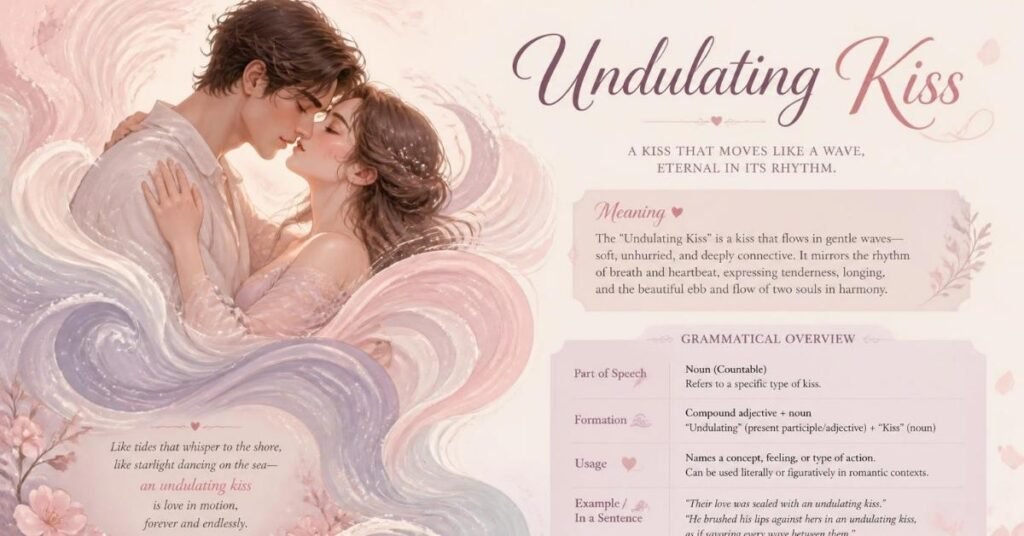
“Undulating” is the describing part and “kiss” is the thing being described. Together they paint a picture of a flowing movement instead of a quick peck.
You’ll mostly meet this phrase in romantic novels, poetry, and relationship blogs. It sets a mood before you even read the next sentence.
Key grammatical and meaning points
- Undulating works as an adjective here, and it comes from the verb undulate.
- Kiss works as a noun in this phrase, though it can also be a verb elsewhere.
- The phrase carries a literal meaning (physical wave-like motion) and a figurative meaning (an emotional rhythm).
Meaning of Undulating Kiss

At its core, the phrase describes a kiss that moves in soft, repeating swells. Think of ocean waves rolling in, pulling back, and rolling in again.
Emotionally, it points to tenderness and emotional closeness. The kiss isn’t rushed. Both people seem to move with the same natural rhythm.
Undulating Kiss Definition
Definition: a slow, gentle kiss defined by gradual movement, soft pressure changes, and a steady, wave-like pace. It signals affection, comfort, and mutual affection.
Worth knowing: no dictionary lists “undulating kiss” as its own entry. Dictionaries define undulating and kiss separately, and writers combine them for effect.
Origin & Etymology
The word undulate traces back to Latin. It grows out of undula, a “little wave,” which itself comes from unda, meaning wave.
English borrowed the word to describe anything that moves or looks like a wave. That’s why we say undulating hills and undulating fabric. The romantic use is a later, figurative step.
Detailed Usage
Writers use “undulating” for anything with a smooth, repeating curve. Undulating music swells and fades. Undulating dance movements ripple through the body.
Pairing it with “kiss” borrows that same sense of motion. The phrase signals soft movement and a slow pace without needing a long explanation.
In Romantic Relationships
Couples use the phrase to describe kisses that feel unhurried and in sync. It often shows up when partners talk about trust, patience, and emotional safety.
It also fits long-term couples. After years together, familiarity can turn a kiss into a habit. A slower, wave-like kiss can make it feel fresh again.
In Literature and Poetry
Poets love it because it creates visual imagery in two words. You can almost see the swell before the line ends.
In fictional storytelling, it often marks a turning point. A character slows down, and the reader understands the moment matters.
In Artistic or Metaphorical Writing
In artistic writing, the phrase works as a metaphor for emotional harmony. It suggests two people moving together instead of one leading and one following.
Descriptive screenplays use it too. A line like this tells a director the kiss should feel slow and romantic, not hurried.
Undulating Kiss Meaning in Different Languages
The idea travels well. Here are common renderings, though real speakers may pick softer, more natural wording.
French: “baiser ondulant”
Baiser ondulant is the literal version. Careful, though: in casual French, baiser as a verb is vulgar, so many speakers prefer bisou or doux baiser.
Spanish: “beso ondulante”
Beso ondulante reads naturally in Spanish and keeps the wave image. It suits poetry and song lyrics well.
Italian: “bacio ondulante”
Bacio ondulante works the same way. Italian writers might also reach for bacio lento (slow kiss) in everyday speech.
German: “wellender Kuss”
Wellender Kuss is a literal rendering. Native writers often choose wellenförmiger Kuss for “wavelike,” so check with a speaker before publishing.
Undulating Kiss Synonyms
If you want a different word, try gentle kiss, tender kiss, soft kiss, or flowing kiss. Each shifts the feel slightly.
For a deeper mood, use lingering kiss, loving embrace, romantic kiss, or passionate kiss. Pick the one that matches your scene.
Undulating Kiss Antonyms
The opposite is a kiss with no rhythm or warmth. Think abrupt kiss, rushed kiss, mechanical kiss, or awkward kiss.
Add cold kiss, indifferent kiss, emotionless kiss, and forced kiss to the list. These lack emotional presence, which is exactly what the undulating kiss has.
Looks Like Words
Some words sit close in meaning: oscillating, rolling, swaying, rippled, wavelike, and flowing. They all suggest repeating motion.
They aren’t identical. Oscillating feels mechanical, while swaying feels soft and human. For kisses, flowing and swaying usually fit best.
Common Mistakes & Tips
Most errors come from treating a literary phrase like a scientific one. A few simple fixes keep your writing clean.
Mistakes
- Calling it a scientific relationship term. It’s descriptive, not clinical.
- Mixing it up with French kissing. They aren’t the same thing.
- Using it in academic writing without explaining it first.
Tips
- Use it in creative or romantic discussions, where imagery helps.
- Define it in one line when your reader might not know it.
- Pair it with a sensory detail, like breath, pace, or touch.
Cultural & Contextual Insight
Kissing customs vary a lot. Cultural expectations shape where a kiss is welcome, how long it lasts, and who initiates it.
Many cultures link love to nature symbolism: rivers, wind, flowers, and seasons. A wave-like kiss fits that tradition of borrowing from nature.
Related Words / Word Families
The family includes undulation (noun), undulate (verb), and undulatory (adjective, rarer). All point back to unda, the Latin wave.
Close concepts include rhythm, tenderness, affection, and emotional synchronization. They help you describe the feeling without repeating one word.
Reader Interaction / Social Hook
Have you ever read “undulating kiss” in a book you loved? Share the line in the comments. Real examples help other readers see how writers use it.
Know someone who’d enjoy this guide? Pass it along. And tell us which kiss description you’d like us to break down next.
Related Expressions / Slang Evolution
Modern slang prefers short words: “slow kiss,” “melting kiss,” “kiss that lingers.” The fancy phrase hasn’t become slang, and that’s fine.
Online, readers often shorten it to “wave kiss” in casual talk. Expect expressions to keep shifting as people borrow from romantic novels and social posts.
The Deeper Meaning Behind Undulating Kisses
Beyond the motion, the phrase stands for emotional vulnerability. You can’t fake a slow kiss easily. It asks you to stay present.
It also speaks to natural connection. When two people move at the same pace, it feels like mutual understanding without words.
Step-by-Step Technique Guide: Mastering the Waves
Treat this as general kissing technique, not a rulebook. Start with consent and a relaxed mood, then slow everything down.
- Start soft. Begin with light pressure and relaxed lips.
- Build a swell. Increase pressure slightly, then ease off.
- Match your partner. Follow their pace instead of leading hard.
- Breathe. Steady breathing keeps the rhythm natural.
- Pause and reset. A brief break makes the next wave land better.
Psychological Benefits and Emotional Impact
Affectionate touch can help people feel safe and connected. Slow kisses may add to that, though results vary from person to person.
Reduces stress and builds calmness
A slow pace can calm the body. Many people report feeling less tense after relaxed, affectionate contact.
Strengthens emotional bonding
Shared, unhurried moments build emotional closeness. They tell your partner, “I’m here, and I’m not rushing.”
Boosts mood through brain chemistry
Affection is linked to oxytocin, dopamine, serotonin, and endorphins. These are the feel-good chemicals behind emotional well-being.
Improves non-verbal communication
A kiss is a form of non-verbal communication. Slowing down lets you read facial expressions and respond better.
Creates lasting emotional memories
Calm, sensory moments tend to stick. A tender kiss can become one of those emotional memories couples revisit.
Advanced Techniques and Variations
Once the basics feel easy, play with pacing. Alternate slow waves with brief pauses, or add a soft forehead kiss between rounds.
You can also blend in a butterfly kiss or hold a lingering kiss at the peak. Keep checking in with your partner’s comfort.
Undulating Kisses in Relationship Development
In a new relationship, a slow kiss can show care without pressure. It lets both people set the pace.
In a growing relationship, it builds trust. Over time, shared rhythm becomes part of how you two communicate.
Scientific Research on Kissing and Intimacy
Research on kissing is limited, and no study focuses on “undulating kisses” specifically. That’s worth saying plainly.
What we do know: some small studies link affectionate kissing with relationship satisfaction and lower stress hormones. Treat these as hints, not guarantees.
Romantic Storytelling: Undulating Kisses in Literature
Authors use slow kisses to stretch a scene. Time seems to slow down, and the reader leans in.
You’ll find this in romantic novels, where a single kiss can carry a whole chapter’s tension. The phrase helps set that romantic atmosphere.
Film and Media Examples of Undulating Kisses
Film shows the idea more than it names it. Think of a cinematic kiss in the rain, a wedding scene, or a farewell moment that lingers.
Long-awaited reunions and romantic sunsets often use slow, wave-like pacing. Directors rely on it to make an audience feel the emotion.
How to Read Your Partner’s Cues During an Undulating Kiss
Look for positive body language: relaxed body language, smiling, and leaning closer. These suggest your partner is enjoying the pace.
Watch for hesitation or pulling away. If you notice either, slow down or stop and check in. Mutual respect always comes first.
Undulating Kiss Myths vs. Facts
Myth: it’s a formal technique with official steps. Fact: it’s a descriptive phrase, and every couple does it differently.
Myth: it only suits long relationships. Fact: anyone can enjoy a slow kiss. Myth: it takes practice to “get right.” Fact: attention matters more than skill.
How to Transition from a Simple Kiss to an Undulating Kiss
Start with a normal kiss, then gradually slow your pace. Let the pressure rise and fall in small waves.
Keep your body relaxed and your eyes soft. If your partner follows, you’re in sync. If not, return to a simple kiss.
The Science Behind Why Undulating Kisses Feel Good
Lips have dense sensory nerves, so gentle, varied touch gets noticed fast. Slow changes in pressure can feel richer than constant pressure.
Add the brain chemistry from affection and a calm mood, and you get a pleasant loop. Exact effects differ, so don’t expect identical results.
Undulating Kisses and Relationship Satisfaction
Couples who share regular, tender touch often report feeling closer. A slow kiss is one easy way to add that touch.
It’s not a cure for deeper problems. But as part of healthy intimacy, it supports relationship satisfaction and communication.
Tips for Making Your First Undulating Kiss Memorable
Pick a calm, private moment. Put away phone distractions and let the mood settle.
Keep it simple: slow pace, soft touch, steady eye contact before and after. Nervous? Smile. Your partner probably feels the same.
Common Misconceptions About Undulating Kisses
Some think it must be long and dramatic. It doesn’t. A short, slow kiss can still feel wave-like.
Others assume it’s always sexual. It isn’t. It can be sweet, comforting, or romantic without being intense.
How Age and Experience Affect the Undulating Kiss
Younger people may rush from nerves. That’s normal, and comfort grows with time.
With age and relationship experience often come emotional maturity and attentiveness. Many people find slower kisses feel more natural then.
Undulating Kiss Etiquette: When and Where It’s Appropriate
A slow kiss suits private settings best. In public, keep it brief, since public displays of affection vary by place and culture.
Always respect social boundaries. Read the room, and let your partner’s comfort guide you.
How to Practice the Undulating Kiss Solo (Yes, You Can!)
You can’t practice chemistry alone. But you can practice mindfulness: slow breathing, relaxed lips, and an unhurried pace.
Some people also practice the rhythm on the back of their hand. It’s a harmless way to build kissing confidence before a real moment.
Using an Undulating Kiss to Rekindle Romance
When routines take over, a slow kiss helps. It breaks the autopilot and says, “I see you.”
Pair it with meaningful conversations and small romantic gestures. Together they help with reconciliation and renewed emotional connection.
Undulating Kiss vs. Other Kissing Styles: Understanding the Differences
A peck is quick. A French kiss is deeper. A butterfly kiss uses eyelashes. A hand kiss is formal and respectful.
The undulating kiss is defined by pace and rhythm, not by where lips go. That’s why it overlaps with other styles.
Body Language Signals During an Undulating Kiss
Good signs include a relaxed jaw, steady breathing, and comfortable eye contact afterward. These suggest mutual comfort.
Tension, stiffness, or turning away signal it’s time to pause. Trust what your partner’s body tells you.
Undulating Kiss Techniques for Beginners
Begin with the basics: relaxed lips, light pressure, and slow timing. Skip complicated moves.
Focus on communication instead of performance. Ask what your partner likes, and adjust. Beginner kissing advice always boils down to listening.
Conclusion
An undulating kiss is a slow, wave-like kiss that blends tenderness, rhythm, and emotional connection. It’s more a feeling than a formal technique.
Use it in your writing for strong imagery, or in real life for a calmer, more present moment. Either way, patience and mutual respect do the heavy lifting.
FAQs
Is an undulating kiss a real kissing technique?
Not as a formal technique. It’s a descriptive phrase for a slow, wave-like kiss.
What does “undulating” mean?
It means moving in a smooth, wave-like pattern. It comes from Latin unda, “wave.”
Is an undulating kiss the same as a French kiss?
No. A French kiss describes deeper contact, while “undulating” describes pace and rhythm.
Can long-term couples experience an undulating kiss?
Yes. Slow, attentive kisses often help long-term couples feel close again.
Why do writers use the phrase?
It creates quick visual imagery and signals a slow, emotional moment.
Is there one correct way to perform an undulating kiss?
No. Follow your partner’s comfort and keep the rhythm gentle and natural.

Mubeen is a passionate writer and content creator who enjoys sharing useful, engaging, and easy-to-understand information. With a focus on well-researched and reader-friendly content, Mubeen aims to help readers discover valuable insights and reliable information.