
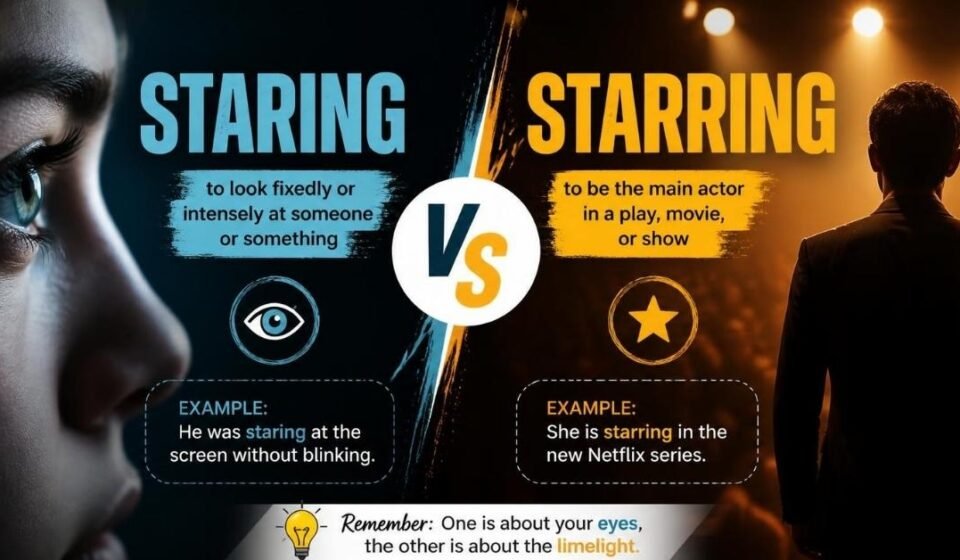
Ever typed “she was starring at me” and then froze? You’re not alone. This one trips up students, writers, and even seasoned editors.
Here’s the short version. Starring is about acting and leading roles. Staring is about looking fixedly at something. Let’s break it all down in plain English.
Starring
Starring is the present form of star when it’s used as a verb. It describes someone who plays a main role in a movie, show, or play. Think of a name at the top of a movie poster.
Staring
Staring is the present form of stare. It means looking for a long time with your eyes wide open and your attention locked in. Think of someone staring at a screen while a download crawls along.
Starring or Staring : Quick Answer ✅⚡
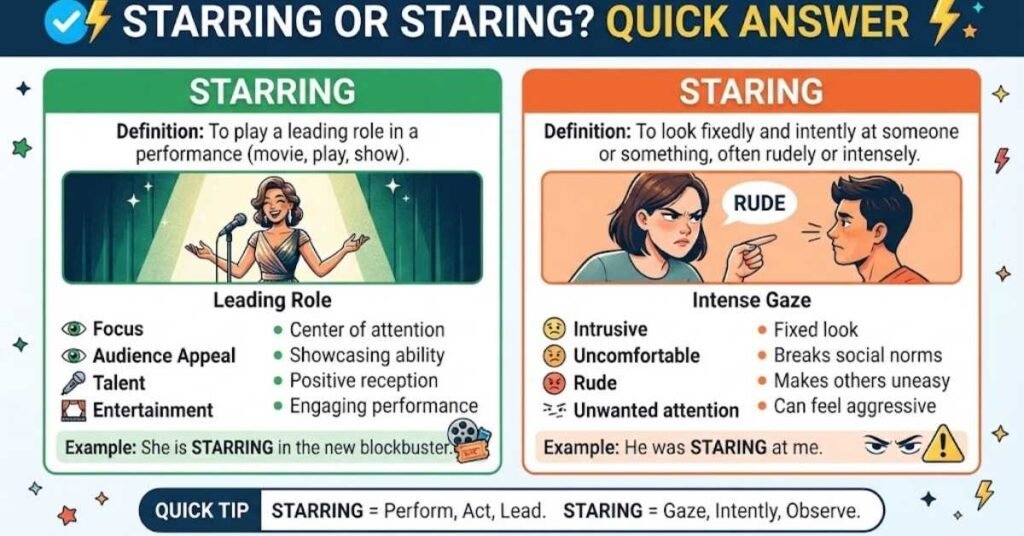
Use starring when you talk about acting or performing. Use staring when you talk about eye focus and vision. That’s the whole game.
One word lives on a stage. The other lives in your eyeballs. Once you see it that way, the spelling confusion fades fast.
✔ Main Difference:
Starring means playing the lead actor or main character in a production. Staring means looking closely or looking without blinking at a person or thing. One is acting, the other is looking.
📌 Examples:
- She is starring in a new action film this summer.
- He kept staring at the clock during the meeting.
- The Netflix series is starring two award-winning actors.
- Why are you staring at me like that?
Starring or Staring : Definitions with Examples 📖✍️
Let’s get proper definitions on the table. Knowing the meaning in context is the fastest cure for word choice mistakes. Each word has one job, and they rarely overlap.
🟢 Starring (Definition)
Starring is the -ing form of the verb “to star.” It means featuring someone as the main performer in a film, TV series, or play. It can also describe a person who takes the leading role in a project.
Some dictionaries also list a looser sense, where someone or something plays a central part. For example, a chef can be “starring” in a cooking show. The idea stays the same: someone is the center of attention on stage or screen.
📌 Examples:
- The movie is starring a young actor from Karachi.
- She spent ten years starring in television shows before moving to film.
- Starring Tom Hanks is a common line on movie trailers.
🔵 Staring (Definition)
Staring is the -ing form of the verb “to stare.” It means looking fixedly at someone or something, often for longer than usual. People stare out of curiosity, surprise, boredom, or deep thought.
It carries a bit of tone too. Staring at a stranger can feel rude, while staring at the sky on a quiet night feels peaceful. Context decides the mood.
📌 Examples:
- The toddler was staring at the birthday cake.
- I caught myself staring at a painting for ten minutes.
- He sat staring at his phone, waiting for a reply.
🟡 Simple Meaning
Here’s a trick you can say out loud. Starring equals acting. Staring equals looking. If you can swap in “acting,” pick starring. If you can swap in “looking hard,” pick staring.
What Does “Starring” Mean in Movies and Films? 🎬
In the film industry, starring signals who headlines the show. You’ll see it on movie posters, streaming platforms, and entertainment news pages. It tells viewers who they’re paying to watch.
The word separates lead actors from featured actors. A film might say “Starring Actor A and Actor B, with Actor C.” The first names carry the main roles, and the “with” name is a smaller part.
It works in TV series and plays too. A Netflix series might promote its acting career boosters in the trailer. A theater poster might say “starring” above the title. Same logic, different stage.
If you’re writing a blog about popular movies, double check your spelling here. A typo like “staring Brad Pitt” changes the meaning from a lead role to someone gazing at him. That’s a funny image, but it’s not what you meant.
The Origin of Starring or Staring 📜⏳
Both words grew out of old roots, but they took different roads. Looking at their etymology makes the split feel natural. Let’s trace each one.
Starring:
Starring comes from star, which traces back to the Old English word “steorra.” People used star for the lights in the night sky. Later, theater folks borrowed the image for famous performers who shone brighter than the rest.
By the 1800s, “to star” had become a verb in show business. A performer could star in a play. Add -ing, double the r, and you get starring. That’s the word formation behind the double “r” spelling.
Staring:
Staring comes from stare, which goes back to the Old English word “starian.” It meant to look fixedly or to gaze with wide eyes. The sense of rigid, fixed attention has stayed put for centuries.
Since stare ends in a silent e, the English spelling rules drop it before -ing. That gives you staring. One r, one clear job.
Starring or Staring : Usage Differences 🌍
The two words look close, but they live in different worlds. Starring belongs to entertainment context. Staring belongs to daily life, social interactions, and eye movement.
They’re also different in feel. Starring sounds professional and polished. Staring can sound casual, awkward, or even a little intense.
Pronunciation helps too. In most accents, starring sounds like “STAR-ing,” with the long “ah” sound from star. Staring sounds like “STAIR-ing,” with the vowel from “stair.” They’re similar-sounding words, but not perfect homophones for most speakers.
📊 Comparison Table:
| Feature | Starring | Staring |
| Root word | Star | Stare |
| Word type | Verb (present participle) | Verb (present participle) |
| Core meaning | Playing a lead role | Looking fixedly |
| Common setting | Movies, TV, plays | Daily life, emotions |
| Spelling clue | Double r | Single r, silent e dropped |
| Example | Starring in a film | Staring at a wall |
Which Word Should You Use? 🎯📝
Picking the correct word gets easy once you ask one question. “Is this about performing or about looking?” Your answer decides everything.
Don’t overthink it. A quick check before you hit publish saves you from an embarrassing typo.
✔ Use “Starring” When:
- You’re naming the lead actor or main performer.
- You’re writing a movie poster, trailer, or entertainment news post.
- You’re describing someone with a leading role in a show or play.
✔ Use “Staring” When:
- You’re describing someone looking for a long time.
- You mean eye focus on a person, object, or screen.
- You’re writing about curiosity, shock, boredom, or deep thought.
🧠 Easy Memory Trick
Try this: starring has two rs, like a spotlight with two beams on the main character. Staring has a clean “a” and “i,” like the eyes you’re using to look.
Another handy one. If the word is about stars on screen, think star plus “r” plus ing. If it’s about eyes, think “stare” minus “e” plus ing.
Common Mistakes with Starring or Staring ❌⚠️
Most errors come from speed, not ignorance. Spell-check won’t help because both are real words. That’s why these common spelling mistakes slip through.
1. Mixing Both Words
Writers sometimes swap them in the same paragraph. A line like “The actor was staring in the movie while starring at the camera” falls apart. Read it aloud and the mix-up jumps out.
2. Wrong Context
Saying “she is staring in a drama series” is a classic grammar mistake. The writer meant acting, but wrote looking. Always match the word to the situation.
3. Spelling Confusion
Some people write “staring” with a double r by accident, or “starring” with only one. Remember, the double “r” spelling belongs to starring only.
4. Ignoring Meaning
Autocorrect can choose the wrong one on your phone. If you rely on it blindly, you’ll end up with “starring at me” in a text. Pause and check the meaning in context.
Difference Between Staring and Starring 👀🎭
Let’s put the difference between starring and staring in one clean picture. One is performance, the other is vision. One is entertainment, the other is daily life.
Another angle: starring needs a production behind it, like a film, show, or play. Staring needs only a pair of eyes and something to look at.
And here’s a bonus point. You can be staring while someone else is starring. Picture a fan staring at the movie screen while their favorite actor is starring in the film. Both words, one scene, zero confusion.
Starring or Staring in Everyday Examples 💬📱
Real sentences stick better than rules. Here are example sentences from everyday English, grouped by where you’d actually use them.
🏠 Daily Life
- My cat spent all morning staring at a bird outside.
- “Why are you staring at me?” she laughed.
- Dad was staring at the wall, lost in thought.
In daily chat, staring shows up far more than starring. It’s part of common expressions like “staring into space.”
📱 Social Media
- Weekend plan: staring at my screen while the new series loads. 🍿
- Can’t wait for the movie starring my favorite actress! 🎬
- POV: you’re staring at your inbox on Monday.
Social media captions love both words. Just pick the right one, since a wrong letter can turn a hype post into a joke.
📚 School
- Exam tip: don’t spend ten minutes staring at one question.
- Our class watched a documentary starring a famous naturalist.
- The teacher marked “staring” in red for a starring sentence.
In school writing, English assignments, and school exams, this pair shows up in vocabulary and spelling tests. Learn the rule once and you’re set.
💼 Professional Use
- Our new campaign is starring a well-known local athlete.
- Please avoid staring at your phone during client calls.
- The ad features a short film starring two featured actors.
In workplace communication and formal English, accuracy matters. A mistake in a press release looks careless.
Starring or Staring : Usage Trends & Popularity 📊📈
People search for this pair because it’s easy to doubt yourself. The words are close, the stakes feel small, and the doubt is real. That’s classic search intent for correct word selection.
📌 Trend Insight:
Staring appears more often in daily conversation because everyone looks at things all the time. Starring spikes whenever a big film production or streaming platform release hits the news. Searches for the difference tend to rise around movie premieres and exam seasons.
I’m not quoting exact figures here, since numbers shift constantly. For live data, you can check Google search trends and compare both terms yourself. It takes a minute and gives you a fresh picture.
Comparison Table 📋⚖️
Here’s a side by side view that sums up the whole article. Save it, screenshot it, or tape it to your monitor.
| Point | Starring | Staring |
| Meaning | Playing the main role | Looking fixedly |
| Context | Entertainment | Everyday life |
| Root | Star | Stare |
| Old English link | steorra | starian |
| Spelling rule | Double r | Drop the silent e |
| Sound | STAR-ing | STAIR-ing |
| Example | A film starring a rising actor | A kid staring at a toy |
Common User Queries 🔍🔥
People ask the same handful of things again and again. Here are the related search queries, answered fast.
What is the difference between starring and staring? Starring means acting in a lead role, while staring means looking fixedly at something.
Is it “staring at me” or “starring at me”? It’s staring at me. Looking at someone is always staring, never starring.
How do you use starring in a sentence? “The new thriller is starring a famous actor from Lahore.” The word follows the production and introduces the lead.
Why are starring and staring confusing? They share five of seven letters and sound alike in fast speech. That mix creates confusing similar words for many learners.
Starring vs. Staring: Quick Tips for Learners 🧩
Here are a few habits that help. They work for English learning tips in general too.
First, link each word to a picture. Starring is a poster with a name on it. Staring is a pair of wide eyes. Second, say each word in a full sentence three times. Your ear starts to catch the pattern.
Third, keep a small list of commonly confused words in your notes app. Add pairs like Naive or Nieve, Peoples vs. People’s, and Definitely or Definately. Review it weekly and your vocabulary grows without any pain.
Why Spelling Matters More Than You Think ✍️
You might wonder if one wrong letter really matters. It does. A single typo can change the contextual meaning of a sentence.
Imagine a headline reading “Singer staring in new musical.” Readers will chuckle, then doubt your credibility. For bloggers, journalists, and students, that doubt costs trust.
Clean writing shows care. Good spelling accuracy makes your message clear, and language clarity keeps readers with you.
Conclusion 🧾📌
Starring is for acting and leading roles. Staring is for looking and eye focus. If you remember that split, you’ll rarely slip.Use the memory tricks, check the double “r” spelling, and read your sentence aloud. A five second pause beats a public typo every time.
Did this clear things up? Drop a comment with the pair of words that confuses you most, and share this guide with a friend who writes a lot. We’ll keep the list fresh in 2026.
FAQs ❓💡
1. Are starring and staring the same?
No. Starring is about acting in a main role, and staring is about looking fixedly. They only look alike on the page.
2. Which one means acting?
Starring means acting, specifically playing a leading role in a film, show, or play.
3. Which one means looking?
Staring means looking, especially for a long time with strong attention.
4. Can they be used interchangeably?
No. Swapping them changes the meaning, so each word needs its own context.
5. Which is more common?
Staring is usually more common in everyday conversation, while starring shows up heavily in entertainment news and movie promotion.
6. Easy way to remember?
Think “star plus r” for starring, and “stare minus e” for staring. Also, starring goes with stars on screen, staring goes with eyes.
7. Is spelling important here?
Yes. One extra or missing letter can turn a leading role into a long gaze, which confuses readers and hurts your credibility.

Mubeen is a passionate writer and content creator who enjoys sharing useful, engaging, and easy-to-understand information. With a focus on well-researched and reader-friendly content, Mubeen aims to help readers discover valuable insights and reliable information.