
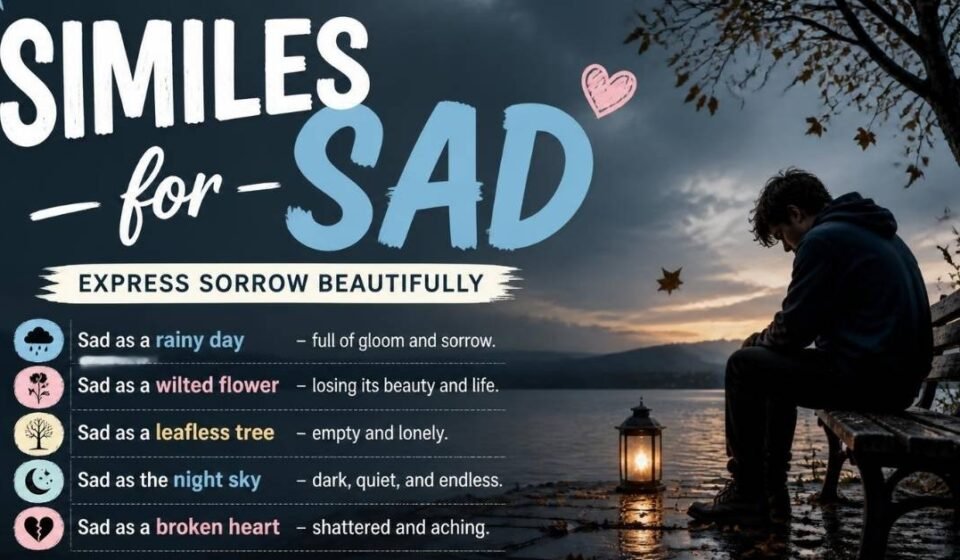
Need a simile for sadness fast? Try sad as a rainy day, sad like a lost child, or sad as an empty room. Each one turns a heavy feeling into a picture your reader can see.Ever stared at a blank page while your character cried, and every line sounded flat? Maybe you’re a student who needs emotional depth in an essay by Friday.
This guide gives you 24 similes for sadness, plus tips to use them in poems, stories, songs, and essays. Read it once, then bookmark it for your next draft.
Quick Definition of a Simile
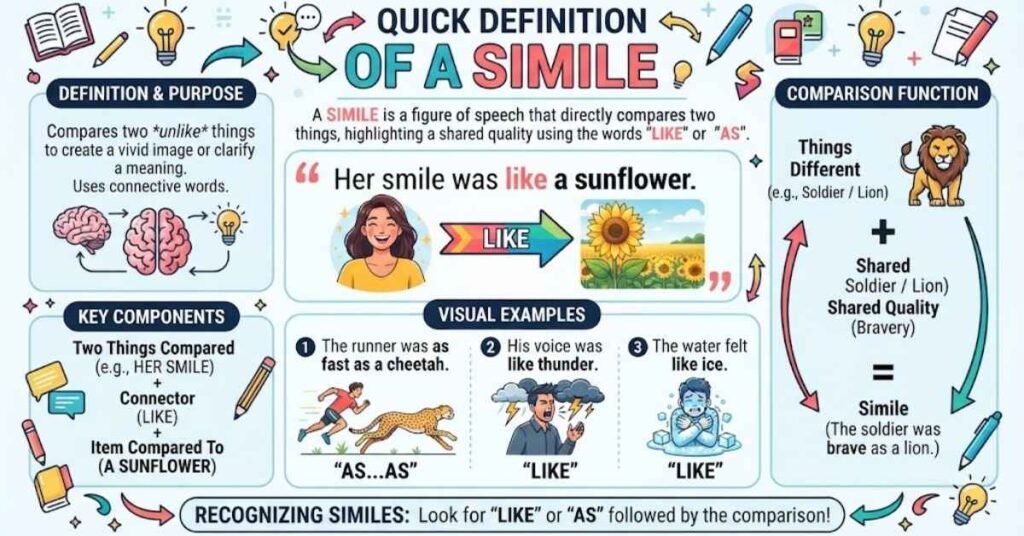
A simile is a figure of speech that compares two things using “like” or “as.”
Think “cold as ice” or “quiet like a library.”
It’s one of the simplest literary devices, and that’s why it works.
Your reader already knows the second thing, so they instantly feel the first.
A metaphor skips “like” and “as” and says one thing is another.
We’ll cover that difference again in the FAQs.
Quick Overview Table of Similes for Sadness
Here’s the full list at a glance.
Scan it, pick a mood, then jump to the detail below.
| Simile | Best For | Feeling It Carries |
| Sad as a rainy day | Poems, captions | Quiet gloom |
| Sad like a lost child | Stories | Feeling lost |
| Sad as a broken mirror | Essays | Shattered self image |
| Sad like a dying flower | Poetry | Slow emotional loss |
| Sad as an empty room | Fiction | Emotional emptiness |
| Sad like a cloudy sky | Everyday speech | Mild heaviness |
| Sad as a forgotten song | Lyrics | Being forgotten |
| Sad like a sinking ship | Drama | Emotional collapse |
| Sad as winter without snow | Poems | Cold with no comfort |
| Sad like fading light | Reflective writing | Slow hopelessness |
| Sad as a silent forest | Fiction | Loneliness |
| Sad like fallen leaves | Autumn poems | Letting go |
| Sad as a crying baby | Dialogue | Helpless, raw upset |
| Sad like a dark night | Essays | Deep sorrow |
| Sad as an abandoned house | Stories | Abandonment |
| Sad like melting ice | Poetry | Slow breakdown |
| Sad as a lonely star | Songs | Isolation |
| Sad like a wilted rose | Love poems | Heartbreak |
| Sad as an empty heart | Lyrics | Numbness |
| Sad like broken wings | Stories | Lost freedom |
| Sad as cold rain | Descriptive writing | Bleak, unwelcome mood |
| Sad like a lost traveler | Fiction | Confusion, no direction |
| Sad as fading memories | Memoir | Grief over time |
| Sad like a silent tear | Poems, captions | Hidden sadness |
Full List of Similes for Sadness
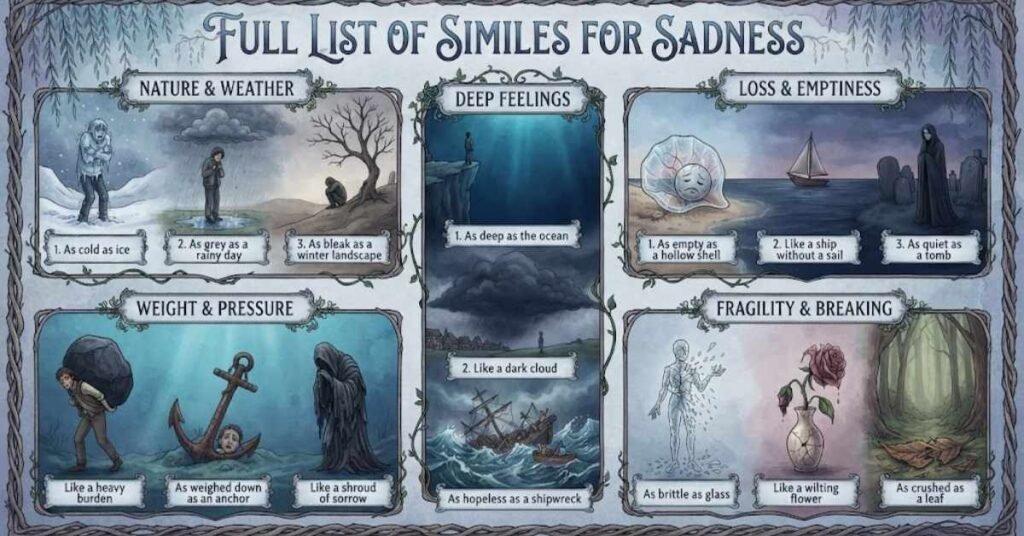
Every simile below comes with a plain meaning and a spot where it fits.
Use them as they are, or twist them into your own.
Sad as a rainy day
Rain makes everything slower, grayer, and quieter.
That’s why this simile suits a low mood with no clear cause.
Try it in a caption or a first line of a poem.
“She woke up sad as a rainy day, and nobody asked why.”
Sad like a lost child

Picture a kid in a crowded mall, eyes wide, no parent in sight.
That panic and feeling lost is what this simile carries.
It works well for character emotions in stories.
Use it when your hero feels small and out of their depth.
Sad as a broken mirror
A cracked mirror still shows you, but in pieces.
It fits inner pain after a blow to someone’s confidence.
Essays on identity love this one.
It says “I’m still here, just not whole.”
Sad like a dying flower
Petals droop a little more each day.
That slow fade mirrors emotional loss that won’t leave.
It’s a strong pick for poetry about illness or ending love.
Pair it with soft, short lines.
Sad as an empty room
No furniture, no voices, just echo.
This simile nails emotional emptiness in a few words.
Fiction writers use it after a breakup or a move.
Describe the room first, then let the reader connect the dots.
Sad like a cloudy sky
Clouds don’t always mean a storm.
Sometimes it’s just gray for days, and that’s the point.
Use this for mild, lingering sadness in everyday expression.
It’s gentle, so it won’t overwhelm a light scene.
Sad as a forgotten song
Remember a tune you loved once, now buried under newer playlists?
That quiet ache is the feeling forgotten.
Lyrics and songwriting suit this line well.
It hints at a person nobody calls anymore.
Sad like a sinking ship
Slow, heavy, and hard to stop.
This one captures emotional collapse as it happens.
Save it for dramatic moments like a job loss or a family fight.
It’s loud, so use it once per piece.
Sad as winter without snow
Winter promises sparkle, then hands you bare brown ground.
It’s cold with no comfort, and that’s a special kind of letdown.
Great for poems about missing joy that never showed up.
It also pairs nicely with nature imagery.
Sad like fading light
Late afternoon, and the room dims without anyone touching a switch.
That’s how hopelessness can creep in.
Reflective writers reach for this one often.
It suits light and darkness themes.
Sad as a silent forest
Trees stand still, and no birds sing.
The quiet feels heavy, like loneliness with a green backdrop.
Use it for a character walking away from a crowd.
It sets the mood without a single tear.
Sad like fallen leaves
Autumn shows beauty and loss side by side.
Leaves let go, and that mirrors quiet sorrow.
It’s a soft fit for autumn poems and goodbye scenes.
Readers usually feel it before they can explain it.
Sad as a crying baby
A baby can’t explain what hurts.
That raw, helpless cry is the heart of this simile.
It works best in dialogue or casual talk.
Skip it in formal essays, where it may sound off.
Sad like a dark night
Darkness hides the road ahead.
So this simile stands for deep sorrow and uncertainty together.
Pair it with a small light, like a porch lamp, for contrast.
That tiny detail adds emotional depth.
Sad as an abandoned house
Peeling paint, dusty windows, a swing that still creaks.
Every detail whispers abandonment.
Stories about feeling abandoned love this image.
Let the house stand in for a person who got left behind.
Sad like melting ice
Ice looks solid until it isn’t.
This simile shows a person slowly losing their hold.
It fits emotional pain that builds quietly.
Use it when a strong character finally cracks.
Sad as a lonely star
One star, huge sky, nobody near.
It’s isolation in a single picture.
Songs and night poems use this a lot.
Try adding a small twist so it doesn’t feel borrowed.
Sad like a wilted rose
Roses stand for love, so a wilted one says heartbreak fast.
Readers get it without extra setup.
It’s popular, so make it yours.
Name whose rose it was, and the line hits harder.
Sad as an empty heart
This one is blunt and numb.
There’s no drama, just a hollow space where feeling used to be.
Use it for characters who’ve stopped reacting.
It carries emotional emptiness without fancy words.
Sad like broken wings
Birds are made for freedom, so clipped wings sting.
It fits a person who can’t chase their dreams right now.
Stories about setbacks and recovery suit it well.
It also sets up a comeback arc nicely.
Sad as cold rain
Warm rain feels fine, but cold rain soaks you and stays.
That’s a sad mood with no cozy corner.
It’s great for descriptive writing and city scenes.
Add a detail like wet shoes for a real touch.
Sad like a lost traveler
A map that makes no sense, and nightfall coming.
That mix of confusion and fear is what you’re after.
Use it when a character has no plan and no support.
It works in fiction and personal essays.
Sad as fading memories
You can’t hold on to a face or a laugh the way you used to.
That slow slip is pure grief.
Memoir writers use it for lost loved ones.
Keep the tone tender, not dramatic.
Sad like a silent tear
A single drop, no sound, no scene.
It shows hidden sadness that someone tries to hide.
Perfect for short captions and tight poetry.
Less is more here.
Turn Your Sadness Into Beautiful Words: Creative Writing Tips
You don’t need a big vocabulary to write well.
You need honest emotional expression and one clear picture at a time.
Below are quick ways to use each simile in your creative writing.
Try one this week and see how it feels.
Use in Poems
Poems are short, so one strong comparison can carry a stanza.
Pick a simile, then build two lines of vivid descriptions around it.
Keep the rhythm simple.
Let the emotional imagery do the heavy lifting.
Use in Stories
Show a character’s mood through what they notice.
A sad person sees the rain, the empty chair, the unread text.
Drop a simile right when the feeling peaks.
That’s when reader connection gets stronger.
Use in Songs
Lyrics need pictures that stick after one listen.
Similes like “sad as a forgotten song” fit because listeners can hum along.
Repeat the comparison in the chorus.
Change one word in the last verse for a fresh feel.
Use in Essays
Academic writing allows similes, but sparingly.
One good comparison in an intro or conclusion is plenty.
Student essays shine when the simile supports the point.
Never let it replace evidence.
Tips for best results:
- Keep it fresh. If you’ve heard it a hundred times, twist it.
- Match the mood. A gentle sadness needs a gentle image.
- Stay specific. “Sad as a wet mitten on a radiator” beats a vague guess.
- Use one per paragraph. Too many similes crowd the page.
- Read it aloud. If it sounds forced, cut it.
How to Create Your Own Original Similes
Borrowed similes are a fine start.
Original ones make readers stop and stare.
Try this quick method.
Name the feeling, list three objects you saw today, then link one object to the feeling using “like” or “as.”
Say your morning bus was late and packed.
“Sad like a bus that skips your stop” is oddly specific, and that’s why it sticks.
Common Mistakes to Avoid With Similes
The first trap is the cliché.
“Sad as a rainy day” is fine once, but a whole page of stock lines feels tired.
The second trap is mismatched tone.
A goofy comparison in a serious scene breaks the spell.
The third is overloading.
Three similes in one sentence make readers dizzy, so pick your best and drop the rest.
Simile vs Metaphor in Emotional Writing
Both are figurative language tools, but they feel different.
A simile says “sad like a wilted rose,” which keeps a small gap between the feeling and the image.
A metaphor says “she was a wilted rose,” which hits harder and feels bolder.
Use similes for gentle, relatable human emotions, and metaphors when you want a sharper punch.
Conclusion
Similes for sadness help you say what plain words can’t.They turn emotional pain into pictures your reader can hold.Pick two or three from this list, bend them to fit your voice, and test them out loud.
Which one hit you hardest? Drop it in the comments, and share this guide with a writer friend who needs it.
FAQs
What is a simile for sadness?
It’s a comparison that uses “like” or “as” to describe a sad feeling.
“Sad as an empty room” is a simple example.
Why do writers use similes for sadness?
Sadness is hard to explain directly.
A simile gives readers an image, so they feel it instead of just reading about it.
Can similes improve creative writing?
Yes, when you use them with care.
They add emotional depth, sharpen descriptive language, and help readers connect with characters.
What is the difference between simile and metaphor?
A simile uses “like” or “as” to compare two things.
A metaphor states one thing is the other, with no linking word.
Can students use similes in essays?
Absolutely.
Keep them short, relevant, and tied to your argument, and they’ll make your writing stand out.

Mubeen is a passionate writer and content creator who enjoys sharing useful, engaging, and easy-to-understand information. With a focus on well-researched and reader-friendly content, Mubeen aims to help readers discover valuable insights and reliable information.