
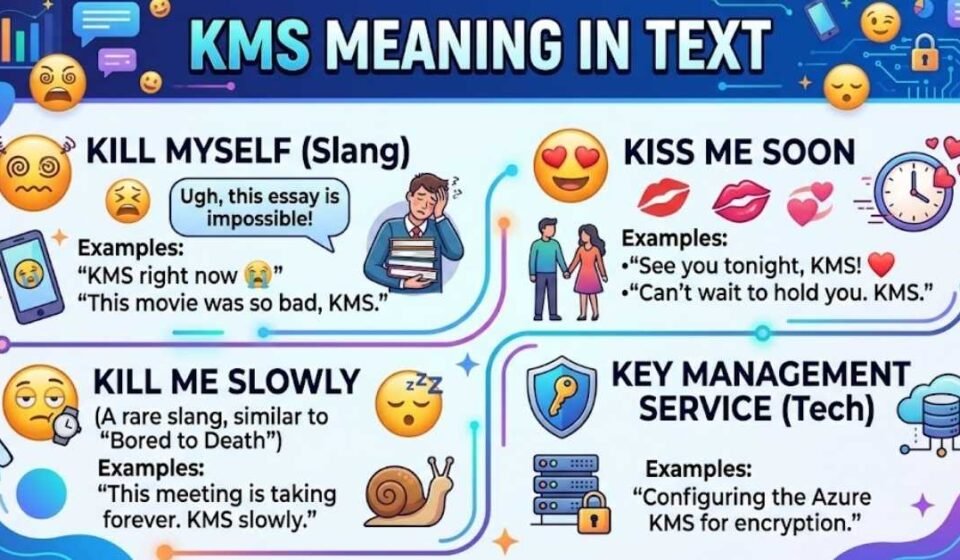
KMS in text most often stands for “kill myself.” People use this texting slang as a hyperbolic expression when they feel embarrassed, annoyed, or overwhelmed. It’s usually dramatic humor, not a real plan. However, the phrase can signal genuine distress, so context and tone matter.
KMS can also mean kilometers in running, driving, and travel talk. Check the sentence around it and you’ll know which meaning fits.
What Does KMS Mean in Text?
Someone just sent you “kms” and you’re not sure how to react. That’s a fair worry.
The KMS meaning in text is “kill myself,” and it’s one of the most common abbreviations in internet slang.
Most of the time it works as emotional shorthand. A person says it after a cringe moment, a rough day, or a bad joke they told.
They aren’t announcing a plan. They’re saying “this feels so awkward I wish the ground would swallow me.”
Still, the words are serious on paper. That’s why this KMS definition comes with a context check, which we’ll cover below.
Tone, emojis, and your history with the sender tell you far more than the letters do.
Simple Meaning of KMS in Everyday Words
Think of KMS as a verbal eye roll aimed at yourself. It’s a way to say “I’m mortified” without writing a full sentence.
Compare it with “I’m dying” after a funny video. Nobody believes the person is actually dying.
The KMS full form is “kill myself.” The phrase belongs to self-deprecating humor, where people poke fun at their own mistakes.
Younger users picked it up because it’s fast, blunt, and feels dramatic.
Here’s the catch. A joke only works when both people read it the same way.
If you aren’t sure how someone means it, treat the message with care and don’t just scroll past.
Where Is KMS Used?
You’ll spot KMS almost anywhere people chat in short bursts. Snapchat, Instagram DMs, WhatsApp, and Telegram are common homes for it.
It also shows up in TikTok comments, Instagram comments, Twitter / X replies, and long Reddit threads.
Discord servers and gaming servers use it a lot too. A player misses an easy shot, types “kms,” and the lobby moves on.
In these online communities, the phrase often works like a groan.
It rarely appears in formal communication or professional communication. You won’t see it in a work email, a school form, or a news report.
That gap says a lot about how casual and context-bound this slang usage really is.
Why Do People Use KMS in Texting?
Speed is the first reason. Typing three letters beats typing a paragraph about your feelings.
Texting culture rewards short, punchy reactions, and “kms” fits that mold.
The second reason is humor. Dramatic overreaction is a big part of internet culture, and exaggeration gets laughs.
Saying “kms” after spilling coffee on your shirt feels funnier than saying “that’s unfortunate.”
The third reason is relief. For some people, joking about overwhelmed feelings makes them feel lighter.
That doesn’t mean the habit is risk free, which is why the later sections on mental health awareness matter.
Real-Life Examples of KMS in Text
Examples beat definitions every time. Let’s walk through five common situations.
Each one shows how meaning depends on context.
Example 1 — Reacting to an Embarrassing Moment
Picture this. You wave back at someone who was actually waving at the person behind you.
You text your friend, “i waved at a stranger like an idiot kms.”
That’s a classic embarrassment expression. Your friend will probably reply with laughing emojis and their own cringe story.
No alarm bells here.
Example 2 — Venting About a Bad Day
Say your boss moved a deadline and your bus got canceled. You message a close friend, “today was brutal, kms.”
It’s venting in its simplest form.
Now notice the difference if the message says, “i’m so tired of everything, kms, nothing helps.” That tone has shifted from a bad day to a heavy one.
A good friend picks up on that and asks a real question.
Example 3 — Reacting to Something Relatable Online
Someone posts a meme about forgetting why they walked into a room. The top comment reads, “kms this is literally me.”
Here the phrase works as a reaction phrase for relatable content.
It’s closer to “I feel seen” than anything dark. The comment section rolls with it.
Still, plenty of readers skip it because it isn’t their style.
Example 4 — In a Friend Group Chat
Your group chat is planning a trip and someone sends a photo of their awful haircut. Three people reply “kms.”
It’s a running bit, and everyone’s in on it.
The friend groups that talk like this usually know each other’s limits. They also notice when someone goes quiet.
That noticing is what keeps a joke from hiding a real struggle.
Example 5 — Reacting to Bad News
Imagine a failed exam or a missed driving test. A student texts, “failed my driving test again kms.”
It’s frustration expression mixed with disappointment.
The best reply isn’t a joke back. Try “that’s rough, want to talk about it?”
You show care without making a big scene.
KMS vs Similar Slang Terms
KMS lives in a family of dramatic reactions. FML (F*** My Life) says “my luck is awful.”
SMH (Shaking My Head) says “I can’t believe that happened.”
The skull emoji and phrases like “I’m dead” or “I cannot” mean “that’s so funny I’m done.” “I give up” signals surrender, usually playful.
All of these are emotional exaggeration in slightly different flavors.
KMS stands apart because it names self-harm directly. FML and SMH don’t.
That’s why some people accept those terms but dislike KMS.
Here’s a quick slang comparison to keep things clear:
| Term | Full form | Usual vibe | Risk level |
| KMS | Kill myself | Dramatic, self-directed | Medium |
| FML | F*** my life | Frustrated | Low |
| SMH | Shaking my head | Disapproving | Low |
| “I’m dead” | Laughing hard | Playful | Low |
| KYS | Kill yourself | Aimed at someone else | High |
When Should You Use KMS?
Honestly, you can skip it entirely and lose nothing. But if you’re going to use it, know your audience.
Audience awareness is the heart of good slang etiquette.
Think of it like swearing at a family dinner. Some tables shrug and others go silent.
The next two sections help you sort the difference.
Situations Where KMS Is Generally Fine
Use it with close friends who share your humor and know you well. Keep it light and tied to something small, like a typo or an awkward wave.
Private chats with people you trust are the safest spot.
It also lands fine in casual conversation around cringe moments everyone laughs at. If the other person has used it first, you’re probably in the clear.
Even then, a quick check-in never hurts.
Situations Where You Should Avoid KMS
Skip it with parents, teachers, older relatives, and anyone who might take it literally. Skip it in workplace communication and other professional settings too.
It’s inappropriate usage there, and it can raise worry or cause real trouble.
Avoid it around anyone who has lost someone to suicide or is going through a hard time. You can’t see their history through a screen.
Also avoid it in public comments where strangers read your words with no context.
Common Misunderstandings About KMS
Slang spreads faster than explanations. So a few myths stick around.
Let’s clear up four of the biggest.
Misunderstanding 1 — KMS Is Always Just a Joke
Most uses are jokes, yes. But “most” isn’t “all.”
Some people hide mental health struggles behind humor because it feels safer than saying the truth out loud. A joke can be a test to see if anyone notices.
That’s why checking on someone is a kind move even when you think it’s nothing.
Misunderstanding 2 — KMS Only Means One Thing
Nope. KMS in messages can also stand for kilometers, a common unit of measurement for distance measurement.
Runners post “10 kms done” after a morning jog, and fitness tracking apps use the same shorthand.
A road trip chat might say, “we’ve got 300 kms to go.” No drama there, just distance.
In tech circles it can even mean Key Management Service, a Microsoft system used for volume software activation.
Misunderstanding 3 — Using KMS Around Everyone Is Fine
Humor travels badly across audiences. What your best friend finds funny might hurt a coworker or scare a grandparent.
The same slang context that works in a gaming server can fall flat in a family WhatsApp group. Responsible communication means matching your words to the room.
When in doubt, pick another phrase.
Misunderstanding 4 — KMS and KYS Are the Same
They aren’t. KMS is self-directed language, while KYS (Kill Your Self) points at another person.
KYS is offensive slang and often used as an insult or in bullying. It falls into harmful phrases that can do real damage.
We’ll break this down more in the FAQ, but the short version is simple. Don’t send KYS to anyone.
Other Meanings of KMS: Kilometers and Software
Since alternative meanings confuse people, here’s a clean rundown. The literal meaning of “kms” in a travel or fitness message is kilometers abbreviation, and nothing more.
You’ll see it on trip plans, running logs, and car dashboards.
Context clues solve it fast. Numbers right before “kms” mean distance.
A sentence about feelings, mistakes, or mood means the slang.
In offices and IT teams, KMS refers to Key Management Service. That’s a licensing tool, not slang.
Mixing these up happens, but the surrounding words almost always settle it.
An Important and Honest Note About KMS
Let’s step out of the jokes for a moment. Words about ending your life can be a real sign of pain.
If someone says KMS and their tone feels flat, hopeless, or different from usual, take it seriously.
Warning signs can include talk about being a burden, pulling away from friends, giving belongings away, or sudden calm after a long low stretch. You don’t need to be an expert to notice these.
You just need to care enough to ask.
Asking directly doesn’t plant the idea. Try, “Hey, I noticed what you said. Are you okay? Are you thinking about hurting yourself?”
Then listen without rushing to fix things.
If someone is in immediate danger, contact your local emergency number right away. If you’re the one struggling, reach out to a trusted person or a local crisis support line, and findahelpline.com lists services by country.
You don’t have to carry this alone, and reaching out is a strong move, not a weak one.
How to Respond When Someone Texts KMS
Start with the tone. If the message follows a silly moment, a light reply fits.
Something like “ha, we’ve all been there” keeps things warm.
If the message feels heavier, slow down. Reply with a real question, such as “That sounds like a lot. Want to talk?”
Empathy works better than advice at this stage.
Don’t panic and don’t mock. Both reactions can shut the conversation down.
Stay steady, stay curious, and keep the door open for later messages.
KMS Alternatives You Can Use Instead
You can get the same laughs without the heavy wording. Try “I’m mortified,” “I can’t even,” or “take me out of this timeline.”
These KMS alternatives keep the drama and drop the risk.
Some people lean on emojis instead. The crying emoji or the skull emoji meaning “I’m done” gets the point across in one tap.
It’s a simple swap that suits mixed audiences.
Others go with “this is so embarrassing” or just FML among friends. Pick what matches your crowd.
The goal is to express emotion clearly without leaving room for a scare.
Pro Tips for Using KMS the Right Way
If you still want to use it, these habits help:
- Know your audience. Close friends only, never with strangers or authority figures.
- Match the moment. Keep it tied to small, silly things like a typo or a spilled drink.
- Watch your tone. If you’re actually down, say so plainly instead of hiding behind slang.
- Notice others. If a friend uses it often or sounds off, check in privately.
- Have backups. Keep a few KMS alternatives ready for public posts and mixed groups.
Language keeps shifting, and Gen Z slang moves quickly. What feels normal on TikTok this year may sound dated or risky next year.
A bit of care today saves awkward moments later.
Final Thoughts
KMS in text usually means “kill myself,” delivered as dramatic humor about embarrassing situations and rough days. It can also mean kilometers, so read the context before youdecide.
Knowing both sides makes you a smarter, kinder texter.The biggest takeaway is simple. Words that sound like jokes can still carry weight, so listen closely and ask when something feels off.
That small habit protects friendships and sometimes more.What’s your take on KMS? Have you seen it used well or badly in your chats? Drop a comment, share this guide with a friend who keeps asking what it means, and check back since we refresh it as slang changes.
FAQs
What does KMS mean in a text message?
In a text message, KMS most often means “kill myself.” It’s a text abbreviation used for hyperbolic expression, usually after something embarrassing or frustrating.
Is KMS always used as a joke?
No. Most people use it for internet humor, but some use it to hint at real pain. A sudden change in tone, repeated use, or hopeless wording are signals worth noticing.
What is the difference between KMS and KYS?
KMS is about yourself, while KYS is directed at someone else. KYS is offensive slang and often shows up in harassment or bullying.
Can KMS mean something other than the slang?
Yes. It commonly stands for kilometers in running, driving, and travel chats. In IT, it can refer to Key Management Service, a software licensing tool from Microsoft.

Mubeen is a passionate writer and content creator who enjoys sharing useful, engaging, and easy-to-understand information. With a focus on well-researched and reader-friendly content, Mubeen aims to help readers discover valuable insights and reliable information.