
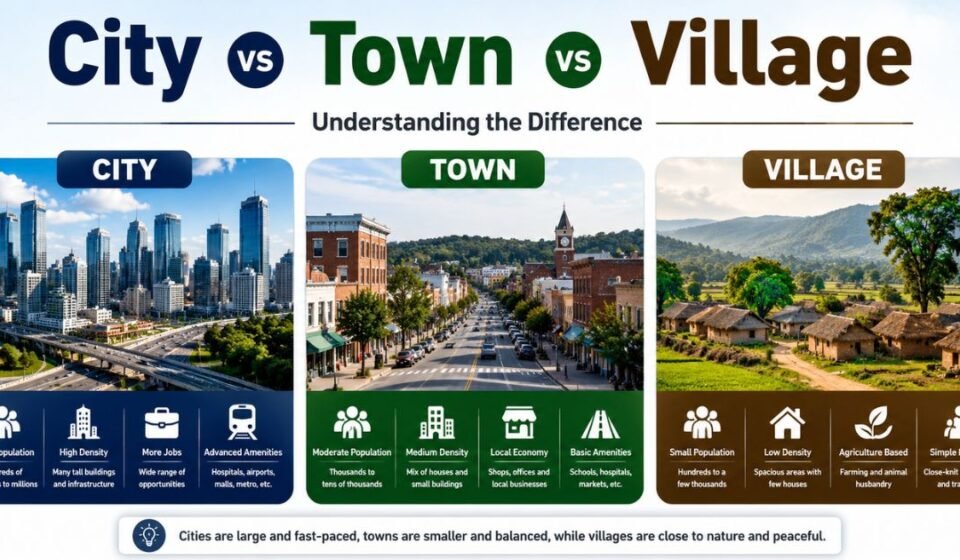
Have you ever wondered why one place is called a city while another, just as busy, is called a town? Or why a tiny settlement with a few hundred people can carry the official title of “city,” while a much larger place stays a “town” forever? These three words, city, town, and village, sound simple on the surface, but they hide layers of history, law, and culture that most people never stop to think about.
This guide breaks down exactly what separates a city from a town from a village. You will learn where these words come from, how population rules differ around the world, and how legal charters shape official status. By the end, you will be able to spot the real difference with confidence, whether you are reading the news, planning a trip, or just settling a friendly debate.
Most people use the words city, town, and village without thinking twice. But these words are not the same. Each one carries its own history, its own rules, and its own feel. Once you know what separates them, you will never mix them up again.
Why These Three Words Confuse
The confusion starts because size alone does not decide what a place is called. A small place with a cathedral can be a city. A large place with thousands of homes can still be called a town. People assume bigger always means “city,” but that is not how it works in most countries.
Language habits also play a role. In everyday talk, people often say “town” for any place that is not their home village, and “city” for anywhere that feels busy. This casual habit blurs the real definitions used by governments and historians.
Media adds to the mix-up too. News reports often swap these words for variety, not accuracy. A place gets called a “city” in one article and a “town” in another, even though only one label is technically correct.
Core Concepts and Historical Evolution
To understand these terms properly, you need to look at where they came from. Each word grew out of a different kind of human settlement, shaped by trade, defense, religion, and government.
Etymology and Charter Systems
The word “village” comes from the Latin “villa,” meaning a country house or farm estate. Villages grew around farming life. People lived close together for safety and shared work, but the whole place stayed small and simple.
“Town” traces back to old English and Germanic words meaning an enclosed or fenced area. Towns grew where trade happened. Markets, roads, and small industries pulled people in, and the settlement grew bigger than a village but still stayed local in feel.
“City” has Latin roots too, from “civitas,” meaning citizenship or a community of citizens. In many countries, especially the UK, a place becomes a city only through a formal charter, often tied to having a cathedral or getting special status from the monarch or government.
Administrative Nomenclature and Legal Mechanics
In legal terms, these words are not just descriptions. They are official titles. Getting the title of “city” often means applying through a formal process, not just growing in population.
| Term | Legal Basis | Common Trigger |
| Village | Local custom or minor administrative recognition | Small population, farming roots |
| Town | Local government charter or municipal status | Market rights, local council |
| City | Royal charter, government decree, or population law | Cathedral status, capital function, large population |
This means a place cannot just decide to call itself a city. Someone with legal authority has to grant that title.
How Population Thresholds Differ Globally
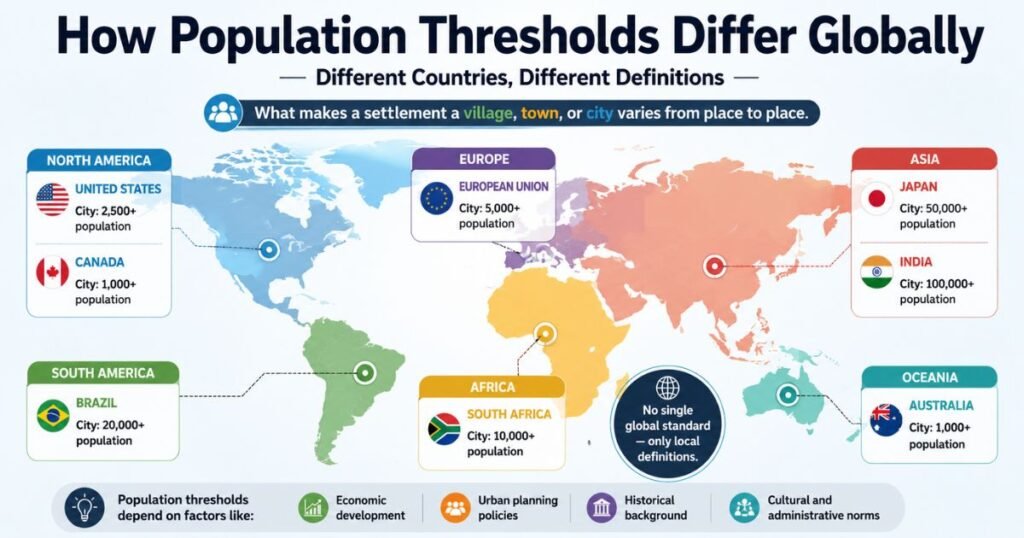
Population size matters, but the exact number needed for each label changes a lot from country to country. There is no single global rule.
United Kingdom Standards
In the UK, city status has nothing to do with population size. It is granted by the monarch, often to mark a special event like a royal jubilee. Some UK cities have fewer people than nearby towns. St Davids in Wales, for example, is a city with a very small population because of its historic cathedral.
United States Framework
In the US, the rules depend on the state, not the federal government. Most states define a city as an incorporated place with its own local government, and towns often have fewer legal powers. Some states use “town” and “city” almost interchangeably, while others set clear population cutoffs.
| Country | Typical City Population Rule | Notes |
| UK | No fixed number, granted by charter | Based on royal or government decision |
| USA | Varies by state, often 1,000 to 50,000+ | Depends on incorporation laws |
| India | Usually 100,000 or more residents | Based on municipal classification |
| Japan | Around 50,000 or more residents | Tied to administrative city status |
International Variations
Many countries set their own thresholds based on local needs. In some parts of Europe, a settlement with just a few thousand people can be called a town, while in parts of Asia, a “town” might have tens of thousands of residents. There is no universal number that fits every nation.
Contextual Examples Across Settlement Types for City vs Town vs Village
Seeing real examples helps make the difference clearer. Words behave differently depending on where and how they are used.
Formal and Administrative Usage
In official documents, land records, and government websites, these terms follow strict definitions. A place listed as a “city” in a government database has met a legal requirement, not just a size guess. This matters for taxes, voting boundaries, and public services.
Casual and Conversational Contexts
In daily conversation, people relax these rules. Someone might call a large town a “city” simply because it feels busy, has tall buildings, or has a shopping mall. This casual use is common and mostly harmless, but it is not technically correct.
The Nuance Trap
The tricky part is when formal and casual meanings clash. A place can be legally a town but feel like a city because of its population and traffic. This mismatch is what confuses most people, including journalists and content writers who are not careful with facts.
Settlement Classifications in Literatur
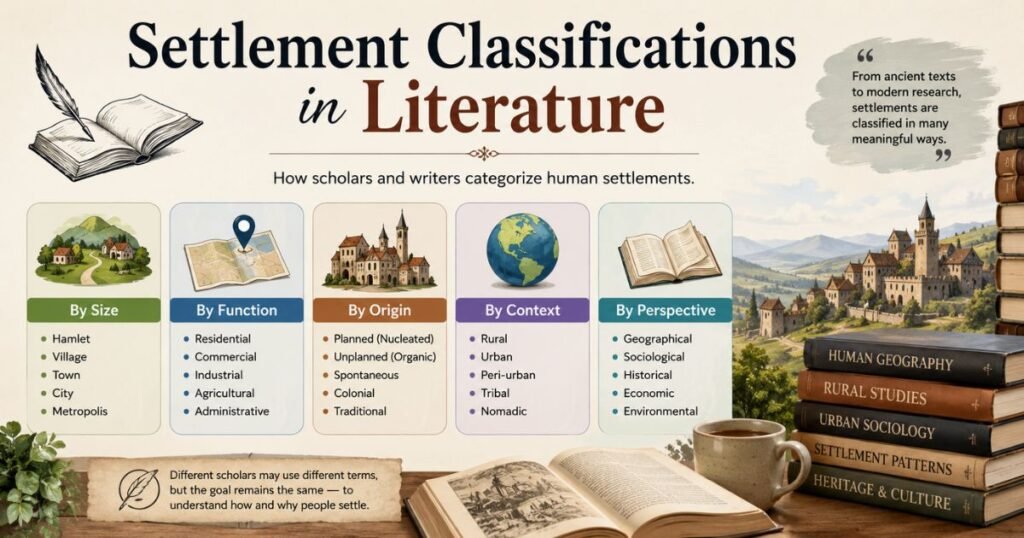
Writers have used these words for centuries, and their choices tell us a lot about how society viewed different places over time.
Classic Literature Analysis
In classic novels, villages often represent simple, quiet, close-knit life. Towns usually appear as places of opportunity, trade, and change. Cities, meanwhile, often stand for ambition, danger, or complexity. Authors picked these settings carefully to set the mood of their stories.
Also Read This:Input vs Imput
Modern Urban Planning Context
Today, city planners use these terms with more precision. Urban planning documents classify settlements based on infrastructure, population density, and economic activity. A “village” in a planning report usually means low density and limited services. A “city” means high density, full infrastructure, and complex governance.
Synonyms and Regional Terminology
Words that mean almost the same thing can still carry small differences in meaning depending on the country or region.
Semantic Neighbors
Here are some common words used alongside or instead of city, town, and village:
- Hamlet: smaller than a village, sometimes just a few homes
- Borough: often part of a larger city with its own local government
- Municipality: a general term for any officially governed area
- Metropolis: a very large and important city, often a hub of culture and business
- Settlement: a broad term for any inhabited place, formal or informal
These words help writers avoid repeating the same three terms over and over, while still staying accurate.
Visualizing Settlement Hierarchy: City vs Town vs Village
Picture these three settlement types as steps on a ladder. Villages sit at the bottom, towns in the middle, and cities at the top. But this ladder is not always about size. It is also about function, governance, and history.
A simple way to picture the hierarchy:
- Village: small population, farming or rural roots, minimal services
- Town: medium population, local trade, basic government structure
- City: large population or special status, full government structure, wide range of services
Regional Variations
This ladder does not look the same everywhere. In some countries, a “town” can be bigger than a “city” in another country. Local history, culture, and law all shape where a place lands on this ladder.
Common Mistakes and Classification Errors of City vs Town vs Village
Even experienced writers and locals get these terms wrong sometimes. Here are the most common mistakes:
- Assuming population size alone decides the label
- Using “city” for any busy or crowded place
- Ignoring official charter or legal status
- Mixing up local terms from different countries
- Forgetting that some cities are small and some towns are large
Avoiding these mistakes takes a little research, but it makes writing and speaking much more accurate.
Practical Tips and Field Notes
Real-world experience often teaches lessons that textbooks miss. Here is a quick story and some simple tips to help you get it right.
When I Corrected a Journalist’s Settlement Error
I once read a news article that called a small English town a “city” simply because it had a large shopping center. The writer assumed size and shopping activity meant city status. In reality, the place had never received a royal charter, so it remained a town by law. A quick check of official records would have caught the mistake before publishing.
Memory Aids for Quick Decisions
Here are a few quick tricks to remember the difference:
- If it has a cathedral and formal charter, it is likely a city
- If it has a market and local council but no charter, it is likely a town
- If it is small, rural, and close-knit, it is likely a village
- When unsure, check the official government or local authority listing
Final Thoughts
Understanding the difference between a city, a town, and a village is not just about memorising definitions. It is about understanding history, law, and culture working together to shape how we name the places we live in. Once you know the real rules behind these words, everyday conversations and news stories start to make a lot more sense.
Next time you visit a new place or read about one, take a moment to check its real status. You might be surprised to learn that a quiet little place is officially a city, or that a busy, crowded area is still legally just a town. This small habit will make you more accurate and more informed in how you describe the world around you.
Frequently Asked Questions
What is the main difference between a city, a town, and a village?
The main difference lies in legal status, population, and history, not just size. Cities often have formal charters, towns have local government structures, and villages are usually small and rural.
Does population size decide if a place is a city?
Not always. Some cities are officially recognized despite small populations, especially in countries like the UK where charter status matters more than size.
Can a town be bigger than a city?
Yes, this can happen in countries where city status depends on legal charter rather than population, so a large town may have more residents than a small city.
What makes a village different from a town?
A village is usually smaller, more rural, and has fewer formal services, while a town has more infrastructure, local government, and commercial activity.
Is city status permanent once granted?
In most cases, yes. Once a place receives official city status, it usually keeps that title even if its population later shrinks.
Do all countries use the same rules for city, town, and village?
No, each country sets its own rules. Population limits, legal processes, and historical customs vary widely across nations.
Why do people often call towns cities in casual conversation?
People often base their language on how busy or developed a place feels, not on official legal status, which leads to casual but technically incorrect use.

Mubeen is a passionate writer and content creator who enjoys sharing useful, engaging, and easy-to-understand information. With a focus on well-researched and reader-friendly content, Mubeen aims to help readers discover valuable insights and reliable information.