
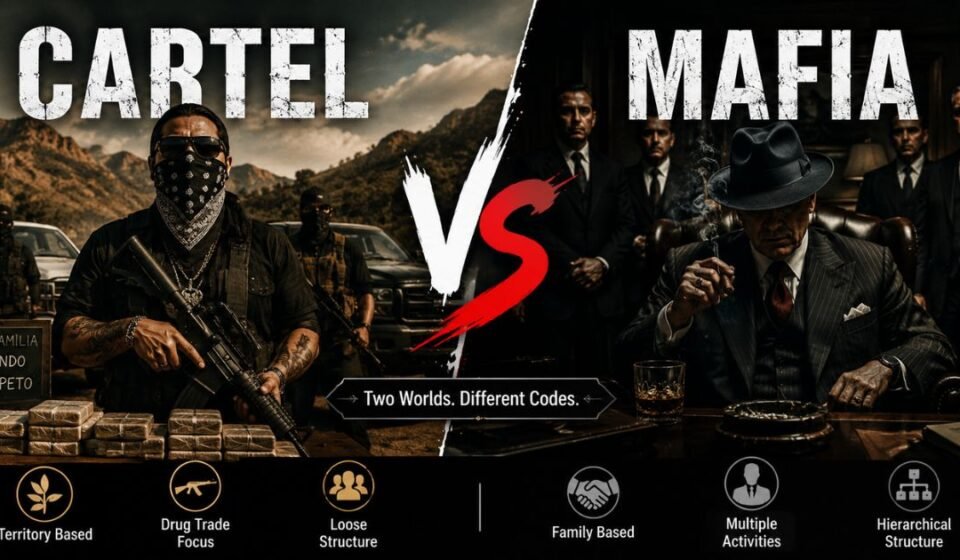
People often use the words “cartel” and “mafia” as if they mean the same thing. They do not. Both words describe organized groups that work outside the law, but the way they operate, and the way English speakers use these words in daily language, is quite different.
This guide breaks down the real difference between the cartel and mafia. It also looks at how the words are used in sentences, common mistakes people make, and how usage changes between American and British English. By the end, you will know exactly which word fits which situation, and why.
Contextual Examples
The word “cartel” usually points to a group formed for a shared business goal, often to control a market or a product. The word “mafia” usually points to a criminal organization built around family ties, loyalty codes, and long-term power structures.
Here are some real-world style sentences that show the difference in action:
| Sentence | Word Used | Why It Fits |
| The drug cartel controlled shipments across three countries. | Cartel | Refers to a business-style criminal network |
| His grandfather was rumored to have mafia connections in Sicily. | Mafia | Refers to a traditional, family-based crime group |
| OPEC is sometimes called an oil cartel because it controls prices. | Cartel | Used outside of crime, in economics |
| The mafia boss demanded loyalty from every member of the family. | Mafia | Focuses on hierarchy and loyalty |
Notice that “cartel” can describe legal or semi-legal groups too, such as businesses that agree to fix prices. “Mafia” almost always carries a criminal meaning tied to organized crime families.
Common Mistakes using Cartel vs Mafia
Many learners of English, and even native speakers, mix up these two words. The biggest mistake is treating them as interchangeable synonyms. They are related in meaning, but not identical.
Here are some common errors:
- Calling any criminal gang a “mafia” when it is really a smaller, informal group.
- Using “cartel” for a family-run crime group that has no business-like trade structure.
- Writing “the mafia cartel” as if it is one single term, which confuses the meaning.
- Assuming both words always refer to Italian organized crime, when the cartel is often linked to drug trade groups in Latin America.
A simple fix is to ask one question before choosing a word: is the group mainly about controlling a trade or product (use cartel), or is it about family loyalty and long-standing crime traditions (use mafia)? This one check clears up most confusion.
American vs British English Differences
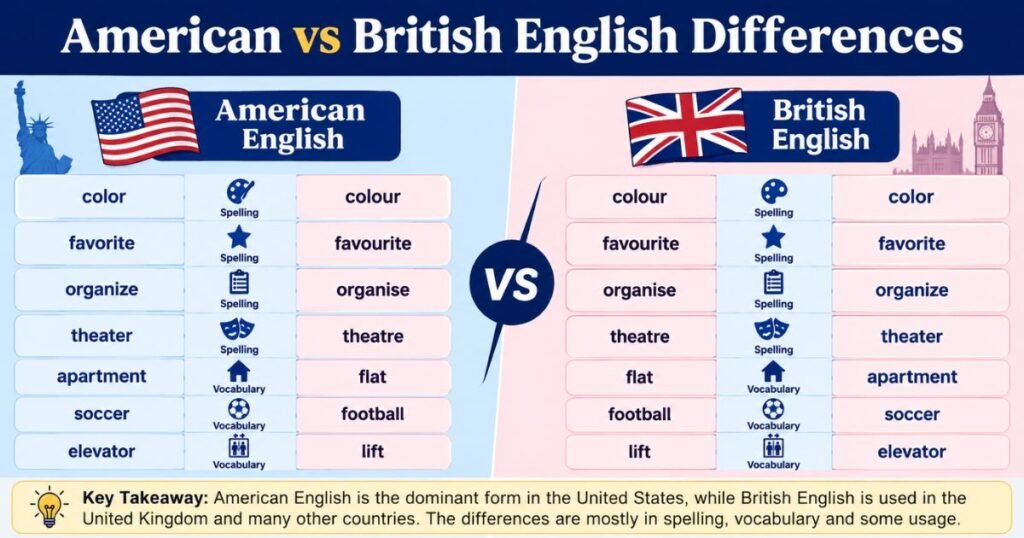
American English and British English use both words, but the frequency and context can shift slightly. In American media, “cartel” is heavily linked to drug trafficking groups, especially those from Mexico and Colombia. News reports, films, and books in the United States use the word constantly in this context.
British English also uses “cartel” for drug groups, but it leans more on the word in business and legal contexts, such as price-fixing cartels among companies. This economic use is common in British newspapers when discussing corporate law.
The word “mafia” is used similarly in both varieties of English, mostly linked to Italian-American or Sicilian organized crime. However, British English sometimes uses “mafia” loosely to describe any tight-knit, powerful group, even outside of crime, such as a “political mafia” meaning an inner circle of powerful people.
| Feature | American English | British English |
| Cartel (crime) | Strongly tied to drug trafficking groups | Used for drugs, but also common in business law |
| Cartel (business) | Less common in daily speech | More common in economic and legal writing |
| Mafia (crime) | Tied to Italian-American organized crime | Tied to Italian and Sicilian crime history |
| Mafia (figurative) | Occasionally used loosely | Used more freely for any powerful inner group |
Idiomatic Expressions
Both words have moved beyond their strict criminal meaning and now appear in idioms and casual speech. These expressions are useful to know because they show how flexible English can be with borrowed words.
Common idiomatic uses include:
- “Media mafia” – used to describe a small group that seems to control what gets published or broadcast.
- “Cartel behavior” – used in business to describe companies secretly working together to control prices.
- “Mafia-style tactics” – describes threats or pressure used to force someone into doing something.
- “Cartel of silence” – a group that agrees, often unspoken, to not speak about a certain issue.
These expressions are common in journalism, casual conversation, and even office talk. They borrow the tone of organized crime to describe control, secrecy, or unfair pressure in everyday situations.
Also Read This: Which One Is You or Are You
Cartel vs mafia vs Yakuza
Adding “Yakuza” into the mix helps sharpen the difference even more. Yakuza refers specifically to Japanese organized crime groups, known for strict codes, tattoos, and a visible, almost formal structure within Japanese society.
Here is a simple comparison of all three terms:
| Term | Origin | Main Structure | Primary Focus |
| Cartel | Often linked to Latin America | Trade or product-based network | Controlling supply, price, or trafficking routes |
| Mafia | Originated in Italy, especially Sicily | Family and loyalty-based hierarchy | Long-term power, protection, and control |
| Yakuza | Originated in Japan | Formal, ranked structure with codes of conduct | Territory control, business fronts, and tradition |
While all three groups operate outside normal law, their internal culture is very different. A cartel is closer to an illegal business operation. A mafia relies on blood ties and old codes of honor. A Yakuza group follows strict rank and ritual, often with public-facing business fronts.
Practical Tips: Choosing Cartel vs Mafia

Choosing the right word does not have to be difficult. A few simple checks can guide you every time you write or speak.
Use these quick tips:
- If the group’s main goal is trade, smuggling, or controlling a product, choose a cartel.
- If the group is built around family loyalty, tradition, and long-term hidden power, choose mafia.
- If you are writing about business collusion or price-fixing, cartel is almost always correct, even outside of crime writing.
- If you want to describe a small, powerful inner circle in a non-criminal context, mafia can work, but use it carefully since it still carries a strong criminal tone.
- When unsure, check the country or culture being discussed. Latin American drug groups are usually called cartels. Italian or Sicilian crime families are usually called mafia.
Keeping these small rules in mind will help you avoid sounding unsure or repetitive in your writing.
Revision Examples With Parts of Speech
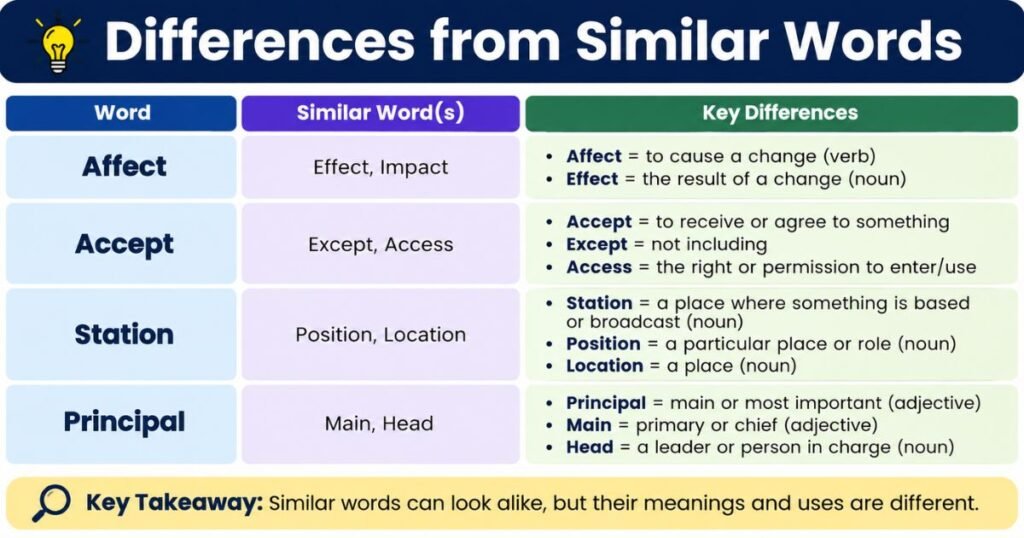
Looking at real sentence revisions helps lock in the difference between these words. Below are examples that show common writing problems and how to fix them using the correct word choice and grammar.
Revision 1 — Fixing Ambiguity
Original: The group ran the entire drug mafia across the border.
Problem: “Drug mafia” is a vague and less accurate phrase. Drug trafficking groups are almost always called cartels in modern English.
Revised: The group ran the entire drug cartel across the border.
Here, “cartel” (a noun) replaces “mafia” to correctly match the trade-based nature of drug trafficking groups.
Cartel vs mafia reddit
Online discussion boards, including Reddit threads, often debate this exact topic. Many users point out that people use “mafia” as a general word for any criminal group, when it should really be limited to family-based crime organizations with historical roots. Reddit users studying language or true crime often note that the cartel fits drug trade groups, while mafia fits older, more traditional crime families.
These informal discussions actually match what language experts say. The words are not random slang. Each one carries a specific cultural and structural meaning that native speakers pick up naturally, even without formal study.
Revision 2 — Correcting Misused Figurative Language
Original: Our office has a real cartel where a few people control every decision.
Problem: This sentence describes a small, tight, loyal group, not a trade-based network. “Cartel” does not fit here.
Revised: Our office has a real mafia where a few people control every decision.
The noun “mafia” better captures the idea of a tight, loyal inner circle holding hidden power, which matches the figurative meaning intended.
Revision 3 — Tense and Agreement Fix
Original: The cartel was smuggling goods for over a decade before it was caught.
Problem: “Cartel” is a singular collective noun in most standard English writing, so it should pair with a singular verb, not a plural one.
Revised: The cartel was smuggling goods for over a decade before it was caught.
Changing “were” to “was” fixes the subject-verb agreement, since “cartel” is treated as one single unit, not several separate people.
Conclusion
Cartel and mafia are not the same word for wearing different clothes. A cartel is built around trade, product control, and business-like coordination, even when that business is illegal. A mafia is built around family loyalty, tradition, and long-standing hidden power. Understanding this difference helps you write clearly and avoid mixing up two words that carry very different meanings.
Once you start noticing the pattern, choosing between cartel and mafia becomes simple. Ask whether the group is trade-focused or loyalty-focused, check the cultural background of the group, and match your verb agreement carefully in writing. With these small habits, your writing will sound accurate, natural, and confident every time these words come up.

Mubeen is a passionate writer and content creator who enjoys sharing useful, engaging, and easy-to-understand information. With a focus on well-researched and reader-friendly content, Mubeen aims to help readers discover valuable insights and reliable information.