
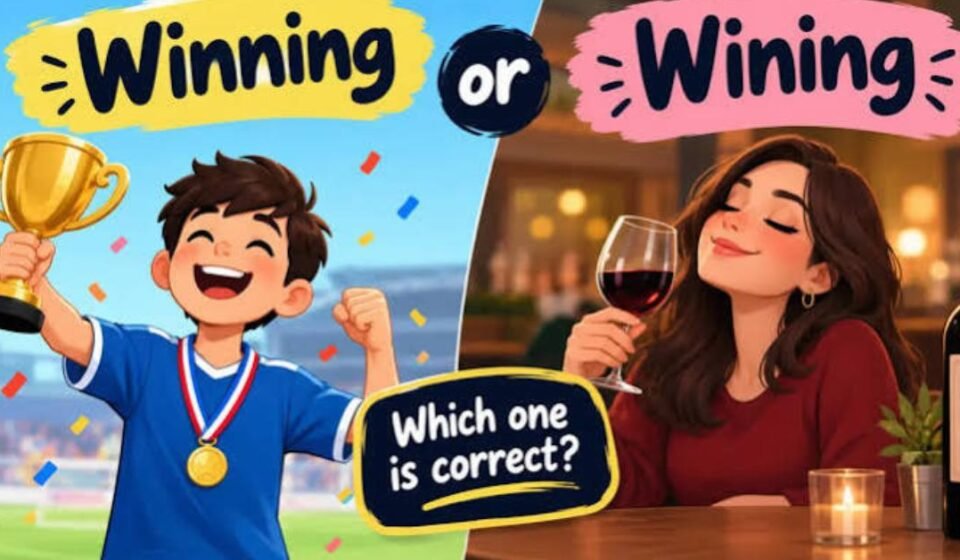
You are typing fast, you reach the end of a sentence, and you stop. Is it “winning” or “wining”? One letter separates a victory from a glass of wine, and that tiny gap trips up students, marketers, and professional writers alike.The confusion is easy to understand. Both words look almost the same on the screen. Both end in “-ing.” Spell checkers rarely complain, because both are real English words.
This guide settles the winning or wining question for good. You will get a direct answer, a side-by-side table, a simple spelling rule, real examples, and answers to the questions people search most.
Quick Answer
“Winning” (two N’s) is the correct spelling when you mean success, victory, or charm. It is the -ing form of the verb “win.”
“Wining” (one N) is a separate word. It is the -ing form of “wine” and means drinking wine or treating someone to wine, as in “wining and dining.”
If your sentence is about a victory, a prize, or a charming smile, write winning.
Quick Comparison Table
| Feature | Winning | Wining |
| Root word | win | wine |
| Spelling rule | Double the final N before “-ing” | Drop the silent E before “-ing” |
| Pronunciation | WIN-ing (short “i,” like “pin”) | WY-ning (long “i,” like “fine”) |
| Main meaning | Gaining victory, or being charming | Drinking or serving wine |
| Part of speech | Verb form, adjective, noun | Verb form |
| Best-known phrases | winning streak, winning smile, winning team | wining and dining |
| How common | Very common | Rare, mostly in one phrase |
| Example | “She is winning the race.” | “He is wining and dining a client.” |
Deep Dive: Winning
“Winning” comes from the verb win, a word that has been part of English since the Middle Ages. It works in three ways.
- As a verb form (present participle): “Our team is winning by two goals.”
- As an adjective: It can describe a victor (“the winning team”) or something charming (“a winning personality”).
- As a noun: “Winnings” means money or prizes you have won.
Why It Has Two N’s
“Win” is a short word with one vowel followed by one consonant. English usually doubles that final consonant before adding “-ing” or “-ed.” The same pattern gives us “running,” “sitting,” “swimming,” and “begging.”
The doubled consonant also protects the sound. The double N tells your eyes to read a short “i,” so the word is pronounced WIN-ing and not WY-ning.
Real-world examples:
- “The winning goal came in the final minute.”
- “After a long losing run, the club is finally winning again.”
- “Her winning smile put the whole interview panel at ease.”
- “He collected his winnings at the end of the night.”
- “Consistency is the winning strategy for most long-term goals.”
- “The company is winning new customers every month.”
Deep Dive: Wining
“Wining” comes from the verb wine, which means to supply with wine or to drink wine. English adds “-ing” to most words ending in a silent E by dropping the E first. That is why “make” becomes “making” and “wine” becomes “wining.”
Dictionaries list “wining” as the standard -ing form of “wine” used as a verb. In everyday writing, you will almost always meet it inside one phrase: wining and dining.
What “Wine and Dine” Means
To wine and dine someone is to treat them to a fine meal, usually with a goal in mind. Businesses wine and dine clients. Hosts wine and dine guests. Partners wine and dine each other on special evenings. Reference works trace the colloquial phrase back to the mid-1800s.
Real-world examples:
- “The firm spent a large budget wining and dining potential investors.”
- “They are wining and dining visiting delegates all week.”
- “He was wined and dined at the city’s finest restaurant.”
- “The festival is known for wining and dining visitors with local vineyards.”
A Note on Pronunciation
“Wining” is pronounced with a long “i,” like “wine.” That makes it sound identical to “whining” (complaining in a high-pitched tone). Spelling “wining” with one N and “whining” with an H keeps those meanings apart. Context almost always tells you which one the writer meant.
Key Differences & Golden Rule to Remember
The two words differ in root, sound, and meaning. The root decides the spelling.
- Winning comes from win, so you add an N and then “-ing.”
- Wining comes from wine, so you drop the E and then add “-ing.”
The Golden Rule
Say the vowel out loud. If you hear the short “i” of “win” and “pin,” use the double N: winning. If you hear the long “i” of “wine” and “fine,” use the single N: wining.
Two Fast Memory Tricks
- The swap test: Replace the word with “victorious.” If it fits, write winning. If you can swap in “drinking wine” or “treating to wine,” write wining.
- The doubling clue: Winning has a “double” because winners often win twice. Wining has a single N because one glass is enough.
Real-World Context & Usage Examples
Knowing the difference is useful, but seeing it in real settings makes it stick. Here is how each word shows up in the places you are most likely to write.
Professional and Email Etiquette
A single wrong letter in a client email looks careless. Spell checkers do not catch this error because both spellings are valid words, so a quick human read-through matters.
- Correct: “We are confident this is a winning proposal.”
- Correct: “Thank you for wining and dining our team last week.”
- Incorrect: “We are wining new accounts this quarter.” (This should be “winning.”)
- Incorrect: “We enjoyed winning and dining with your executives.” (This should be “wining.”)
In sales, finance, and sports reporting, “winning” appears constantly. Phrases such as “winning streak,” “winning bid,” and “winning margin” are common, and each needs the double N. Even published market and sports coverage has been seen with “wining streak” where “winning streak” was meant, which shows how easily the slip happens.
Casual Conversation
In spoken English, the two words sound different. “Winning” has a short “i,” and “wining” has a long “i.” The confusion only appears when we write.
- “I’m winning at this game tonight!” (success)
- “He’s wining and dining her on their anniversary.” (treating her to dinner and wine)
- “That was a winning pitch.” (successful)
In texts and social posts, speed causes most mistakes. A quick glance at the vowel sound you intended is enough to catch them.
Formal Writing
Essays, reports, journalism, and academic papers should follow standard spelling without exception.
- Academic writing: “The winning argument rested on three pieces of evidence.”
- News writing: “The winning candidate thanked her supporters.”
- Hospitality and business writing: “The hotel’s marketing relies on wining and dining corporate groups.”
If you follow a style guide such as the AP Stylebook or the Chicago Manual of Style, both treat “winning” and “wining” as separate words with the meanings above. Check a trusted dictionary like Merriam-Webster, Oxford Learner’s Dictionaries, or Dictionary.com if you are ever unsure.
Common Mistakes to Avoid
These are the errors that show up most often, and how to fix each one.
- Writing “wining streak” instead of “winning streak.” A streak of victories is always “winning.”
- Writing “winning and dining.” The correct phrase is “wining and dining.” You are not winning a meal, you are being treated to one.
- Dropping one N in fast typing. Reread any sentence about success, prizes, or competitions and check for two N’s.
- Using “wine and dining” as a fixed phrase. The base form is “wine and dine.” The -ing form is “wining and dining.” Mixing them creates an awkward hybrid.
- Confusing “wining” with “whining.” They sound the same but mean different things. “Whining” means complaining.
- Trusting the spell checker. Both spellings are valid words, so software often stays silent. Proofread by meaning, not just by letters.
- Forgetting “winnings.” When you mean money or prizes won, the noun is “winnings,” also with two N’s.
Conclusion
The winning or wining question comes down to one idea. If you mean victory, success, or charm, the word is winning with two N’s. If you mean treating someone to wine and a meal, the word is wining with one N, almost always in “wining and dining.”Remember the golden rule: short “i” gets a double N, and long “i” gets a single N. Add the swap test, and you will rarely get it wrong again.
Bookmark this page for the next time you are about to hit send, and share it with a colleague who writes a lot of emails.
FAQs
Is it “wine and dine” or “wine and dining”?
The standard idiom is “wine and dine,” and its -ing form is “wining and dining.” “Wine and dining” mixes the two forms and is best avoided.
Why does “win” become “winning” with two N’s?
“Win” is a short word with one vowel and one final consonant, so English doubles the N before “-ing.” This also keeps the short “i” sound.
Can “winning” ever mean winning?
Yes. “Winning” is the standard word for gaining victory, and it can also mean charming, as in “a winning smile.”
What is the correct spelling for a winning smile?
The correct spelling is “winning smile,” with two N’s. It describes a smile that is charming and attractive.

Mubeen is a passionate writer and content creator who enjoys sharing useful, engaging, and easy-to-understand information. With a focus on well-researched and reader-friendly content, Mubeen aims to help readers discover valuable insights and reliable information.