
Short answer first, because that’s why you clicked.HU in text usually means “Hey You.” It’s a quick, friendly way to grab someone’s attention.But that’s not the whole story. Depending on who sent it, HU can also mean “Huh”, “Hurry Up”, or simply “Hi U.”
The trick is reading the conversation context. One little abbreviation, four possible meanings, and zero punctuation to help you out.This guide breaks down every version, platform by platform, so you never misread a two letter message again.
What Does HU Mean in Text & Chat?
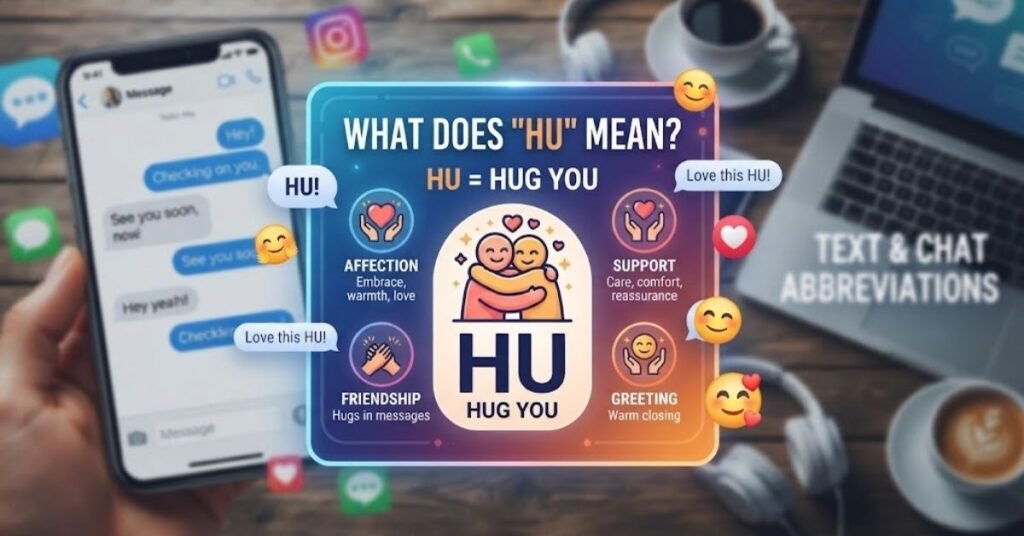
HU is a texting abbreviation that lives almost entirely in casual conversation. Most people use it as a friendly greeting, a softer cousin of “Hey.”
It works like a nudge. Someone types HU when they want your attention without writing a full message.
The second most common reading is “Huh.” Here HU becomes a filler sound, the typed version of that noise you make when you didn’t catch something.
Think of it as confusion compressed into two letters. No emojis, no punctuation, just mild bewilderment.
Less often, HU stands for “Hurry Up.” This one shows up when plans are running late and patience is running thin.
And in SMS texting from people who type fast, HU is just “Hi U” with the vowels knocked out.
Quick examples:
- “HU, you free tonight?” → Hey You
- “HU? say that again” → Huh
- “HU!! bus is here” → Hurry Up
- “HU doing today?” → Hi U / how are you
When Should You Use HU in a Text?
Use HU with friends, classmates, and close contacts. People who already know your typing style will decode it instantly.
It fits quick messaging best. A Snapchat streak, a group chat, a fast reply while you’re walking somewhere.
Skip it in professional emails, business messages, and formal school assignments. Your manager reading “HU” at 9am will not think “Hey You.”
Formal communication needs full words. Formal writing and HU are natural enemies.
There’s also a middle zone worth thinking about. With unfamiliar users, someone you matched with, a new coworker, a seller on Marketplace, HU reads as abrupt.
Write “Hey” instead. Two extra letters, way less misunderstanding.
How to Understand HU From the Tone of a Message
Tone does almost all the heavy lifting here. The same two letters flip meaning based on what surrounds them.
Look at punctuation first. A question mark turns HU into “Huh” nearly every single time.
Exclamation marks push it toward urgency. “HU!!” is someone tapping their foot, not saying hello.
A bare HU with nothing attached? That’s your standard attention grabber, the casual greeting version.
Emojis are the other big clue. “HU 😅” signals uncertainty or surprise, while “HU 😘” is a flirty tone hello.
And honestly, your relationship with the sender tells you more than any rule. Your best friend and your group project partner mean different things by the same word.
Full Form, Stands For & Short Meaning of HU
People search for the HU full form expecting one clean answer. There isn’t one, and any site claiming otherwise is guessing.
HU is a shorthand expression with multiple accepted readings, all valid depending on context.
Here’s what HU stands for in everyday digital communication:
| Meaning | When you’ll see it | Vibe |
| Hey You | Opening a chat, getting attention | Warm, playful |
| Huh | Mid conversation, after something unclear | Confused, casual |
| Hurry Up | Time pressure, plans, meetups | Impatient, urgent |
| Hi U | Fast typing, lazy thumbs | Neutral greeting |
Notice that none of these carry a negative meaning. HU is not a rude meaning or an offensive meaning term in any mainstream usage.
The only way it lands badly is through tone, not through the word itself.
Origin, History & First Known Use of HU
Here’s where most articles invent a tidy origin story. I’d rather be straight with you.
There’s no documented “first use” of HU. No viral post, no dictionary entry, no founding moment.
What we do know is the pattern it belongs to. Phrase shortening exploded in the late 1990s and early 2000s, when SMS had strict character limits.
Every character cost money or space. So early online communication squeezed words down hard, and two letter forms thrived.
HU grew out of that same internet chatting culture as an organic typo turned habit. It never needed a launch, it just stuck.
Internet slang evolution works this way constantly. Social media evolution speeds it up, but the mechanism stays identical: type fast, drop letters, watch it spread.
How People Use HU in Daily Conversations
In practice, HU almost always opens or interrupts. It rarely sits in the middle of a sentence doing quiet work.
Think of it as a doorbell. Short, functional, mildly attention seeking.
Common usage styles:
- Opener: kicking off a chat with someone you text daily
- Interrupter: cutting into a group chat that’s drifted off topic
- Reaction: expressing confusion without typing a whole question
- Nudge: poking someone who’s left you on read for six hours
Examples:
- “HU, did you see what she posted?” → starting a conversation
- “HU where’d you go” → getting someone’s attention after silence
- “HU that makes no sense” → Huh, pure emotional expression
- “HU we’re leaving in 5” → Hurry Up
HU Meaning Across WhatsApp, Instagram, TikTok & Snapchat
Platform dependent usage is real. The same slang term behaves differently depending on where it lands.
Each app has its own rhythm, and HU bends to fit it.
WhatsApp:
On WhatsApp, HU is almost always “Hey You.” Group chats and one on ones both treat it as a greeting.
Because WhatsApp conversations tend to be with saved contacts, the friendly tone reading dominates.
Instagram:
In Instagram DMs, HU often follows a story reaction or a shared reel. It’s a conversation starter with low effort attached.
In Instagram comments, it skews toward “Huh”, usually under something confusing or badly explained.
TikTok:
TikTok comments are the wild west of social media slang. Here HU most often reads as “Huh”, layered with sarcasm.
In TikTok replies, it can also be a playful callout, especially when someone’s dueting or stitching a video.
Snapchat:
Snapchat streaks are built on minimal effort. Streak chats exist to keep a number alive, not to hold deep conversation.
So HU on Snapchat is frequently just a placeholder. Two letters, streak saved, everyone moves on.
Different Meanings of HU in Other Fields
Outside online chat, HU turns into something else entirely. Formal abbreviations don’t care about your group chat.
In academics, HU commonly refers to Harvard University, especially in citations and admissions threads.
In science, HU can mean Hydrogen Unit, tied to hydrogen measurement. In medical imaging it also stands for Hounsfield Unit, used in CT scans.
In engineering, you’ll see Heat Unit, linked to energy output and thermal calculations.
There are also airport abbreviations, company abbreviations, and regional abbreviations using HU. Hainan Airlines uses HU as its IATA code, for example.
None of this affects your texting. But if you Googled HU meaning and got a university page, now you know why.
Common Confusions, Mistakes & Wrong Interpretations
Most wrong interpretation problems come from assuming one fixed meaning. HU simply doesn’t work that way.
Meaning variation is the whole point of the term.
Common mistakes:
- Reading every HU as “Huh.” Plenty of people mean Hey You and get treated like they’re confused.
- Assuming it’s rude. HU carries no built in hostility. Blunt, yes. Rude, no.
- Using it in professional writing. A recruiter will not decode your text slang.
- Ignoring punctuation. “HU” and “HU?” are two different messages.
- Confusing it with HBU. HBU means “How About You,” a completely separate short form.
That last one trips people up constantly. One letter, totally different usage.
Similar Terms, Alternatives & Related Slang
If HU feels too ambiguous, plenty of alternatives do the same job with less guesswork.
Casual greetings like Hey, Hi, Yo, and Sup all land cleanly. Nobody misreads “Yo.”
Stretched spellings add warmth. Heyy and Hii signal friendliness through repeated letters, which is its own quiet language.
What’s up and Wyd push for a response. They’re openers that actually ask something.
Among newer slang and reaction slang, “huhhh” and “wait what” have taken over a lot of HU’s confusion duties. Internet slang terms rotate fast, and longer reaction spellings feel more expressive right now.
Still, HU survives because it’s the shortest option on the list.
Examples of HU in Real Chat Situations
Rules only take you so far. Here’s how HU actually shows up in real chat situations.
Scenario one: Your friend hasn’t replied since yesterday. You send “HU 👀” and she replies “sorry dead phone.”
Pure attention grabber, zero hostility, works every time.
Scenario two: Someone in your group chat says “so we’re meeting at the place.” You type “HU which place.”
That’s Huh, doing its job as an emotional expression of mild chaos.
Scenario three: You’re standing outside the car. Your brother is still inside on the phone. “HU!!!”
Nobody needs a dictionary for that one.
How to Reply When Someone Says HU
Match the tone. That’s the entire strategy, and it almost never fails.
If they sent a relaxed HU, send something relaxed back. If they sent it with three exclamation marks, move faster.
Friendly reply:
- “HU back 😄 what’s up?”
- “Heyy, you good?”
- “hii, missed you”
These work when the HU was clearly a greeting. You’re keeping the casual tone alive.
Casual reply:
- “sup”
- “yo”
- “hm? say that again”
- “omw, chill 😭”
The last one’s for the Hurry Up version. Acknowledge it, defuse it, keep moving.
One thing to avoid: replying “what does that mean” to a friend. It stalls the chat and makes a two second message into a whole thing.
Is HU Safe to Use With Someone You Don’t Know Well?
Short version: not really. HU assumes familiarity that a stranger hasn’t agreed to yet.
With unfamiliar users, two letter messages read as low effort. Sometimes they read as slightly demanding.
There’s also a real risk of the flirty tone reading. “Hey You” has romantic energy baked in, whether you meant it or not.
Send that to a new coworker and you’ve created a problem that didn’t need to exist.
Default to “Hi” or “Hey” with anyone new. Save HU for people who already know how you text.
Is HU Still Popular? Trends & Online Usage
HU hasn’t vanished, but it’s no longer a headline slang term. Its online usage has settled into steady background use.
Usage trends show that longer, more expressive reaction spellings now dominate. “huhhh” beats HU on TikTok almost every time.
Where HU still thrives is quick communication with zero stakes. Streak chats, fast replies, half awake morning messages.
Casual texters keep it alive because efficiency never goes out of style.
Internet slang trends in 2026 lean toward tone heavy typing, stretched vowels, and emoji layering. HU is the opposite of that, which is exactly why it survives as a utility word.
It’s not trendy. It’s just useful.
Conclusion
HU is a small word carrying four different jobs. Hey You, Huh, Hurry Up, and Hi U all live under the same two letters.The meaning comes from context, tone, punctuation, and your relationship with the person typing it.Use it with friends and close contacts. Keep it far away from professional writing and anyone you’ve just met.
And when you’re unsure what someone meant? Ask. “HU as in hey, or HU as in huh?” is a perfectly normal thing to send.Your turn: which meaning do you use most? Drop it in the comments, and if this cleared things up, send it to the friend who texts in abbreviations you can’t decode.
FAQs
1. What does HU mean in texting?
HU most commonly means “Hey You” in texting. It’s a short, friendly greeting used to get someone’s attention in casual chatting.
2. Is HU rude or offensive?
No. HU has no offensive meaning and isn’t considered rude in normal online conversations.
It can feel blunt with unfamiliar users, though, simply because it’s so short.
3. Can HU mean Huh?
Yes, and it often does. When HU appears mid chat with a question mark, it’s working as a filler sound for confusion.
4. Where is HU commonly used?
You’ll see HU across WhatsApp, Instagram DMs, TikTok comments, and Snapchat streaks.
It’s also common in SMS texting and general messaging between friends and classmates.
5. Is HU still used in 2026?
Yes, though it’s more of a steady utility term than a trending one. Casual texters still use it daily for quick messages.

Mubeen is a passionate writer and content creator who enjoys sharing useful, engaging, and easy-to-understand information. With a focus on well-researched and reader-friendly content, Mubeen aims to help readers discover valuable insights and reliable information.