
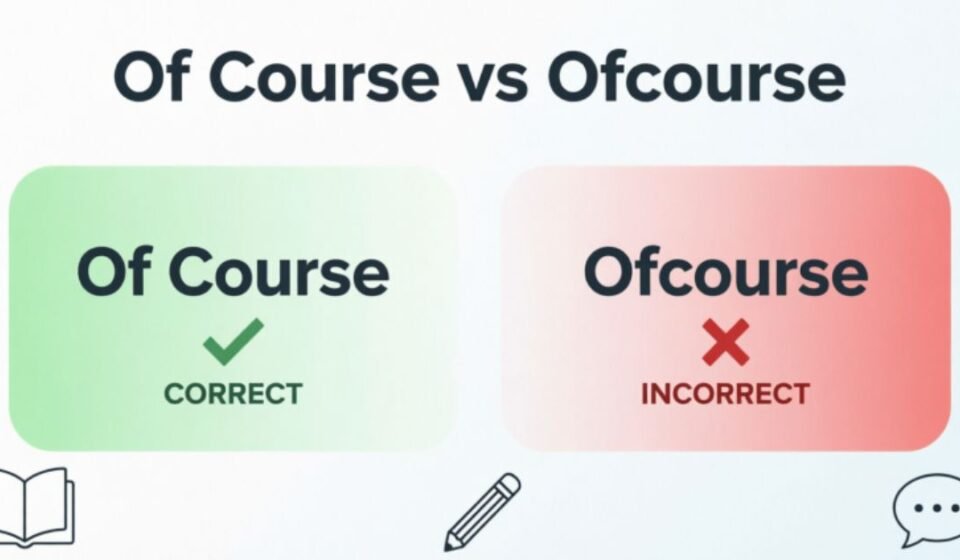
If you have ever paused mid-sentence and wondered whether to type “of course” or “ofcourse,” you are not alone. This is one of the most common spelling mix-ups in English. The short answer is simple: “of course” is correct. “Ofcourse” is not a real word. It never appears in any dictionary, and no style guide accepts it.
But knowing the right answer is not the same as understanding why the mistake happens so often. In this guide, we will look at where this phrase comes from, how to use it correctly, and why so many people, even confident writers, keep merging these two words into one.
Why Does Your Brain Want to Merge These Words?
English is full of phrases that sound like one word but are actually two or more. “Of course” is a perfect example. When we speak, we blend the words together quickly. The “of” and “course” run into each other, and the pause between them almost disappears. Your ear hears one smooth sound, so your brain assumes it should be written as one word too.
This happens with other phrases as well. Think about “a lot,” which many people mistakenly write as “alot.” Or “in fact,” which some try to squeeze into “infact.” Our brains like patterns, and merging small connector words feels natural, even when it is grammatically wrong.
There is also a keyboard habit at play. Fast typing and autocorrect on phones sometimes push words together without us noticing. Once a person types “ofcourse” a few times without correction, the wrong version starts to feel normal. This is how habits form, even bad ones.
Here is a quick look at why the confusion happens:
| Reason | Explanation |
| Speech blending | The words sound connected when spoken aloud |
| Pattern matching | Brain assumes short phrases become single words |
| Typing speed | Fast typing skips the space bar |
| Repeated exposure | Seeing the wrong spelling online normalizes it |
| Similar phrases | Words like “alot” or “infact” create a false pattern |
Core Concepts and Historical Evolution
To really understand why “of course” stays as two words, it helps to look at where the phrase came from and how it developed over time.
Etymology and Latin Roots
The word “course” traces back to the Latin word “cursus,” which means a running or a path. Over time, this word entered French and then English, keeping its meaning tied to direction, progress, or a set path of action. When you say something happens “of course,” you are really saying it follows the natural path or expected direction of events.
The phrase “of course” started appearing in English writing centuries ago. It was used to describe something that followed the normal, expected pattern, much like a ship follows its course. Because “of” and “course” are two separate words with their own histories, they were never meant to be joined. This is a big reason dictionaries have never accepted “ofcourse” as valid.
Of course or ofcourse examples
Seeing real examples side by side makes the difference easy to remember.
Correct usage:
- “Of course, I will help you with the project.”
- “Can I borrow your pen? Of course you can.”
- “She agreed, of course, without any hesitation.”
Incorrect usage:
- “Ofcourse, I will help you.” (wrong)
- “Can I borrow your pen? Ofcourse.” (wrong)
- “She agreed, ofcourse, without hesitation.” (wrong)
Notice that in every correct example, there is a clear space between “of” and “course.” That space is not optional. It is part of correct grammar.
Grammatical Mechanics and Fixed Expressions
“Of course” belongs to a group of English expressions called fixed phrases. A fixed phrase is a group of words that always appears in the same order and is treated as one unit of meaning, even though it is made up of separate words. You cannot rearrange it, and you cannot merge it into a single word.
Grammatically, “of course” works as an adverb. It usually shows agreement, confirms something as obvious, or adds emphasis to a statement. It can sit at the start of a sentence, in the middle, or at the end, and it often gets set off by commas when placed mid-sentence.
Here are the basic rules to remember:
- Always keep a space between “of” and “course.”
- Use a comma before and after “of course” when it appears in the middle of a sentence.
- Use a comma after “of course” when it starts a sentence.
- No comma is usually needed when it ends a short sentence, though many writers still add one for rhythm.
| Position in Sentence | Example |
| Start | Of course, we will attend the meeting. |
| Middle | The plan, of course, needs approval first. |
| End | You can join us, of course. |
Contextual Examples: How “Of Course” Works in Real Sentences
The phrase changes tone depending on where and how it is used. Let us break this down by setting.
Formal and Academic Usage
In formal writing, “of course” is used carefully. It often introduces a point that the writer expects the reader to already agree with, or it softens a claim by acknowledging something obvious before moving to a new idea.
Examples:
- “Of course, further research is needed to confirm these findings.”
- “The results, of course, must be interpreted within their limitations.”
In academic papers, this phrase helps writers sound confident without being harsh. It signals respect for the reader’s intelligence while still making a clear point.
Casual and Conversational Tone
In everyday speech, “of course” is used constantly. It answers questions, confirms plans, and expresses warmth or reassurance.
Examples:
- “Can you help me move this weekend?” “Of course!”
- “Of course I remember your birthday.”
- “It’s fine, of course it is.”
In casual talk, the phrase often carries emotional warmth. It tells the other person that their request or worry is completely reasonable.
Of course or ofcourse grammar
From a pure grammar standpoint, there is no rule, no exception, and no regional variation that allows “ofcourse” to exist as one word. English does not have compound rules that would justify merging these two terms. Spellcheckers, grammar tools, and every major dictionary, including Oxford, Cambridge, and Merriam-Webster, list only “of course” as correct.
If you ever see “ofcourse” in a published book or article, it is a typo, not an accepted alternative spelling.
The Nuance Trap: Correct But Awkward
Writing “of course” correctly is only half the job. The other half is using it in the right place. This phrase can sound rude or dismissive if overused or placed carelessly, especially in written communication where tone is harder to read.
For example, saying “Of course that’s true” in response to someone’s question can sound like you are mocking their intelligence, even if that was not your intent. In professional emails, it is smart to use this phrase sparingly and only when it truly adds warmth or confirms something genuinely expected.
Also Read This: Unselect or Deselect
A few tips to avoid sounding awkward:
- Avoid starting every reply with “of course,” as it can feel repetitive and insincere.
- Do not use it to answer a question that was not obvious, since it can sound condescending.
- Pair it with a warm tone in customer service or professional writing, such as “Of course, I’d be happy to help.”
How “Of Course” Appears in Written Works
This phrase has a long history in literature and continues to shape modern writing style today.
Classic Literature
Many classic authors used “of course” to add natural rhythm to dialogue. It appears often in nineteenth and twentieth century novels, where characters use it to express agreement, sarcasm, or quiet certainty. Writers relied on it because it mirrors how real people speak, making dialogue feel authentic rather than stiff.
Modern Stylistic Applications
Today, “of course” appears everywhere from blog posts to marketing copy to social media captions. Modern writers use it to build a conversational tone, especially in content meant to feel friendly and approachable. Brands often use it in customer support messages to sound reassuring rather than robotic.
Synonyms and Variations: What Means the Same Thing?
Sometimes you want to express the same idea without repeating “of course” too often. English offers several alternatives.
Semantic Neighbors and Functional Equivalents
| Phrase | Tone | Example |
| Naturally | Formal, smooth | Naturally, we expect delays during the holidays. |
| Certainly | Polite, confident | Certainly, I can send that file today. |
| Obviously | Direct, sometimes blunt | Obviously, the deadline matters. |
| Undoubtedly | Strong, formal | Undoubtedly, the results support our theory. |
| Sure | Casual | Sure, I can grab that for you. |
| Absolutely | Enthusiastic | Absolutely, count me in. |
Visualizing the Differences
Think of these words on a scale from casual to formal. “Sure” and “absolutely” sit on the casual end, perfect for texts and friendly chats. “Of course” sits comfortably in the middle, working well in both spoken and written English. “Undoubtedly” and “naturally” lean more formal, better suited for reports, essays, and professional writing.
Choosing the right one depends on your audience. A customer support message might use “of course,” while a research paper might lean toward “naturally” or “undoubtedly.”
Regional Variations and International English

“Of course” is used the same way across British, American, Australian, and other English-speaking regions. There is no regional spelling difference, unlike words such as “colour” versus “color.” The phrase and its meaning stay consistent worldwide.
However, tone can shift slightly by region. In British English, “of course” sometimes carries a drier, more understated tone. In American English, it often sounds warmer and more direct. In both cases, the spelling never changes, and “ofcourse” is incorrect everywhere, regardless of country or dialect.
Common Mistakes: Why Smart People Write “Ofcourse”
Even skilled writers slip up sometimes. Understanding the common causes can help you avoid the mistake going forward.
- Autocorrect confusion: Some phone keyboards fail to catch the merged spelling, especially when typing quickly.
- Non-native language influence: In some languages, similar expressions are written as single words, which can carry over into English writing habits.
- Speed typing: When typing fast, especially in chats or texts, people often skip spaces without noticing.
- Visual memory errors: If someone has seen “ofcourse” written incorrectly online multiple times, their brain may start to accept it as normal.
- Lack of proofreading: Many writers do not reread their work carefully enough to catch small spacing errors.
Table of common online mistakes:
| Platform | Common Error Cause |
| Text messages | Fast typing without proofreading |
| Social media | Copying casual writing habits from others |
| Emails | Autocorrect or rushed typing |
| Student essays | Confusion from spoken language patterns |
Practical Tips and Field Notes: How to Never Make This Mistake Again
Fixing this habit is easier than it sounds. With a few small changes, you can train yourself to always get it right.
The Editor’s Field Note
Professional editors suggest reading your sentence out loud and pausing naturally at “of” and “course.” If you can hear a small break, that break should show up as a space in your writing too. Editors also recommend using a reliable grammar checker as a second layer of protection, especially for important documents like resumes, emails, or reports.
Another trick editors use is searching your document for “ofcourse” before submitting any written work. This quick search habit can catch mistakes that your eyes might otherwise skip past.
Mnemonics and Memory Aids
Memory tricks make it easier to lock in the correct spelling for good.
- Remember: “Of” is a tiny word, and it always stands alone, just like “a” or “an.”
- Think of “course” as a path, like a race course. A path needs space around it.
- Say the phrase slowly in your head: “of… course,” with a clear gap between the two.
- Compare it to “of the,” which nobody writes as “ofthe.” The same logic applies here.
With a bit of practice, correct spelling becomes automatic, and the merged version stops showing up in your writing altogether.
Conclusion
“Of course” is the only correct way to write this phrase. “Of course” is a common typing mistake, not an accepted spelling, no matter how often it appears online. The confusion mostly comes from how naturally the words blend together when we speak, along with fast typing habits and auto correct slips.
Once you understand where the phrase comes from and how it works grammatically, the correct spelling becomes second nature. Keep the space, use commas where needed, and choose the right tone for your audience, whether that is formal writing or a casual chat. With a little attention and the memory tips shared above, you will never second guess this phrase again.

Mubeen is a passionate writer and content creator who enjoys sharing useful, engaging, and easy-to-understand information. With a focus on well-researched and reader-friendly content, Mubeen aims to help readers discover valuable insights and reliable information.