
English spelling rules can be confusing, especially when it comes to words that use prefixes. One question that comes up a lot is whether you should write “reevaluation” or “re-evaluation.” Both forms look correct at first glance, and you have probably seen each one used in books, articles, and online content.
The truth is that both spellings are accepted in modern English. However, there are small differences in when and where each version is used. This guide will walk you through the correct usage, real examples, and simple tips to help you remember which spelling fits your writing style.
By the end of this article, you will know exactly how to use “reevaluation” and “re-evaluation” with full confidence. You will also understand why some writers prefer the hyphen while others drop it completely.
Is “Reevaluation” or “Re-evaluation” Correct?
Both “reevaluation” and “re-evaluation” are grammatically correct. Neither spelling is wrong. The difference mostly comes down to style, region, and the publication you are writing for.
In American English, many style guides and dictionaries lean toward dropping the hyphen. This gives you “reevaluation” as one solid word. Merriam-Webster, a widely used American dictionary, lists “reevaluation” as the standard spelling without a hyphen.
In British English, writers often keep the hyphen. This gives you “re-evaluation.” The hyphen helps separate the prefix “re” from the root word “evaluation,” which some readers find easier to read at first glance.
Here is a simple breakdown of the difference:
| Spelling | Common Region | Style Preference |
| Reevaluation | American English | Modern, cleaner look |
| Re-evaluation | British English | Traditional, clearer separation |
So which one should you use? The answer depends on your audience. If you are writing for an American audience or using American style guides like AP or Chicago Manual of Style, go with “reevaluation.” If you are writing for a British or international audience, “re-evaluation” is a safer choice.
Some publications also use the hyphen when the double “e” in “reevaluation” looks awkward or hard to read. This is a stylistic choice rather than a strict grammar rule.
“Reevaluation” vs “Re-evaluation” in Practice: Usage Examples
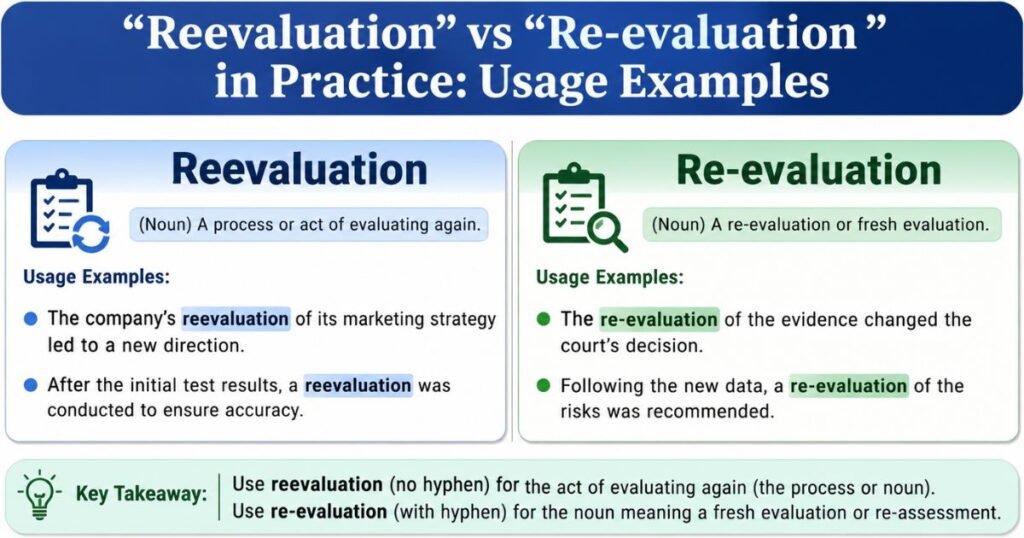
Seeing these words in real sentences makes the difference much easier to understand. Below are correct and incorrect usage examples that show how each spelling works in everyday writing.
Reevaluation or re evaluation example
Both versions can be used in professional, academic, and casual writing. The word usually refers to the act of assessing something again, often after new information becomes available or after some time has passed.
Correct Usage Examples
Here are some sentences that use both spellings correctly:
- The manager asked for a reevaluation of the project budget before the next meeting.
- After the new test results came in, doctors ordered a re-evaluation of the treatment plan.
- The company’s reevaluation process helps identify weak points in customer service.
- Teachers often request a re-evaluation of a student’s academic progress each semester.
- The board approved a reevaluation of company policies to match current laws.
Notice that in each sentence, both spellings work perfectly well. The meaning does not change based on the hyphen. What changes is simply the visual style of the word.
Incorrect Usage Examples
There are, however, some spelling mistakes that should be avoided. These are not accepted in either American or British English:
- “Reevaulation” (letters are misplaced)
- “Re evaluation” (missing hyphen and written as two separate words without a connector)
- “Reeevaluation” (extra letter added by mistake)
- “Re–evaluation” (double hyphen, which is a typo)
If you ever see “re evaluation” written as two words with a space and no hyphen, that is incorrect. The prefix “re” must always connect to the word “evaluation” either directly or with a hyphen. A blank space between them breaks the grammar rule.
Reevaluation or re evaluation meaning
The meaning of both “reevaluation” and “re-evaluation” is exactly the same. It refers to the process of looking at something again to check its value, accuracy, or condition. This could apply to a project, a decision, a health condition, a financial plan, or even a relationship.
Also Read This: Cartel vs Mafia
The word comes from two parts:
- Re meaning “again”
- Evaluation meaning “an assessment or judgment of something”
When combined, the word simply means “to evaluate again.” This is a useful word in business, healthcare, education, and everyday conversations where reassessment is common.
Context Variations
The word can shift slightly in tone depending on where it is used. Here are a few common contexts:
Business context: A reevaluation often means reviewing budgets, strategies, or employee performance to check if changes are needed.
Medical context: A re-evaluation usually refers to a follow-up check on a patient’s health, treatment, or diagnosis.
Academic context: In schools, a reevaluation might involve checking a student’s grades, skills, or eligibility for a program again.
Legal context: A re-evaluation can refer to reviewing a legal case, contract, or decision after new facts come to light.
No matter the field, the core meaning stays the same. Only the setting changes how the word is applied.
Why Do Writers Add or Drop the Hyphen in Reevaluation?
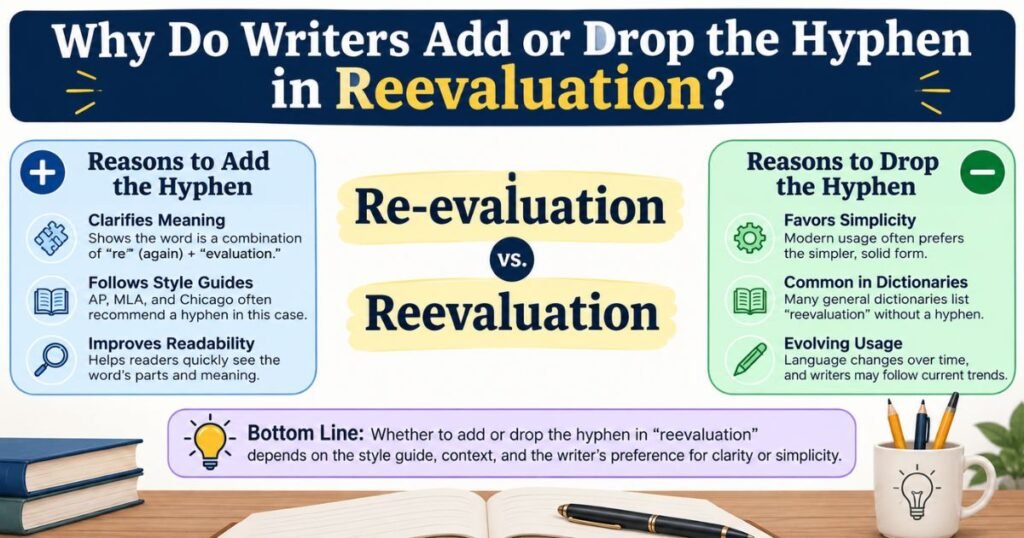
Understanding why some writers choose the hyphen and others do not can help you make a better choice for your own writing. There are a few clear reasons behind this pattern.
First, readability plays a big role. Words with double vowels, like “ee” in “reevaluation,” can sometimes look confusing without a hyphen. Some readers pause for a second longer to process the word. Adding a hyphen breaks up the letters and makes the word easier to scan quickly.
Second, dictionary and style guide preferences matter a lot. American dictionaries like Merriam-Webster favor the closed form “reevaluation.” British dictionaries and many international style guides still prefer the hyphenated form. Writers often follow whichever guide their organization or publication uses.
Third, brand and industry habits also shape spelling choices. Businesses, especially in healthcare and legal fields, often stick to the hyphenated version because it looks more formal and traditional. Tech and modern marketing content, on the other hand, tends to favor the shorter, cleaner “reevaluation” without the hyphen.
Here is a quick table summarizing these reasons:
| Reason | Leads To Hyphen | Leads To No Hyphen |
| Readability preference | Yes | No |
| American English dictionaries | No | Yes |
| British English dictionaries | Yes | No |
| Formal or legal writing | Yes | No |
| Modern digital content | No | Yes |
At the end of the day, both forms are correct. The choice mostly reflects personal style, audience expectations, and regional habits rather than a strict rule.
How to Remember the Right Spelling
If you often mix up “reevaluation” and “re-evaluation,” a few simple tricks can help you remember which one to use.
- Think about your audience. If you are writing for American readers, drop the hyphen. If you are writing for British or international readers, keep it.
- Check your style guide. Many companies and publications already have a preferred spelling listed in their writing guidelines.
- Read it out loud. If “reevaluation” feels hard to read at a glance, add the hyphen for clarity.
- Stay consistent. Whichever version you pick, use it the same way throughout your entire document. Mixing both spellings in one piece of writing looks unprofessional.
- Use a grammar checker. Most modern grammar tools will flag inconsistent spelling and suggest the most common form for your chosen language setting.
A simple memory trick is to remember: “Re” always needs to connect to the next word, either directly or with a hyphen. It should never stand alone with a space before “evaluation.”
Final Thoughts
Both “reevaluation” and “re-evaluation” are correct spellings of the same word. The choice between them comes down to your audience, region, and writing style rather than strict grammar rules. American English tends to favor the shorter form without a hyphen, while British English often keeps the hyphen for clarity.
Whatever spelling you choose, the most important thing is consistency. Stick to one version throughout your writing, follow your style guide if you have one, and keep your audience in mind. With this simple understanding, you will never second guess this word again.

Mubeen is a passionate writer and content creator who enjoys sharing useful, engaging, and easy-to-understand information. With a focus on well-researched and reader-friendly content, Mubeen aims to help readers discover valuable insights and reliable information.