
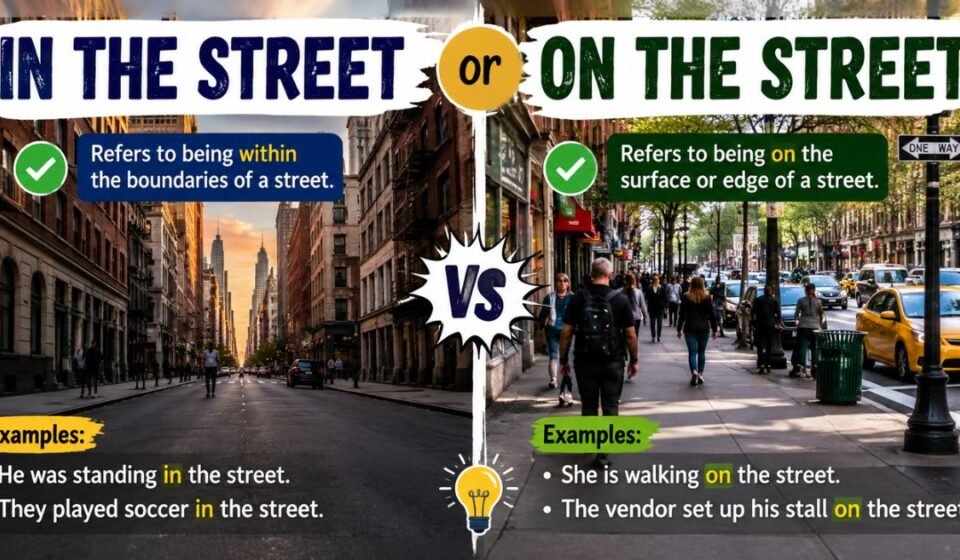
English learners often get stuck on small words like “in” and “on.” These words look simple, but they can change the meaning of a sentence. One common question is whether we say “in the street” or “on the street.” Both phrases are correct, but they are not always used the same way.
This confusion happens because British English and American English treat this phrase differently. It also depends on what you want to say. Are you talking about someone standing on the road? Or are you talking about a shop located along a street? The answer changes based on context.
In this article, we will break down the real difference between “in the street” and “on the street.” We will look at examples, common mistakes, and simple tricks to remember the rule. By the end, you will know exactly which phrase to use and when.
In the Street and On the Street: Examples That Show the Contrast
The easiest way to understand this rule is through examples. Seeing the phrases in real sentences helps the difference feel natural instead of confusing.
In British English, “in the street” is common when talking about people or objects physically present on the road surface. For example, children playing, cars parked, or people walking. American English speakers, on the other hand, almost always say “on the street” in these same situations.
Here is a simple table to show the pattern clearly:
| Situation | British English | American English |
| Kids playing outside | in the street | on the street |
| A car parked outside | in the street | on the street |
| A shop located along a road | on the street | on the street |
| Someone walking along the road | in the street | on the street |
| An address or location | on the street | on the street |
Notice that “on the street” is used in both varieties when talking about a location or an address. The real difference appears mostly when describing people or things physically standing on the road.
Correct Usage Examples
Here are some correct sentences using both phrases:
- “The children were playing in the street.” (British English)
- “The children were playing on the street.” (American English)
- “There is a new bakery on the street.” (Both British and American English)
- “He parked his bike in the street.” (British English)
- “He parked his bike on the street.” (American English)
These examples show that meaning stays the same, but word choice shifts depending on the region and the type of sentence.
Incorrect Usage Examples
Some sentences sound wrong because the preposition does not match the context. Here are examples to avoid:
- ❌ “The store is in the street.” (Sounds odd, use “on the street” for locations.)
- ❌ “He lives on the street number 12.” (Should be “on Street Number 12” or simply “at” the address.)
- ❌ “The car crashed on the street corner in the middle of traffic.” (Should usually be “in the street” for British English when describing something happening on the road surface.)
These mistakes usually happen because learners mix location-based sentences with action-based sentences. Knowing this small difference avoids confusion.
In the street or on the street Cambridge
Many learners search for how the Cambridge Dictionary explains this phrase. According to general Cambridge English guidance, “in the street” is more common in British English, especially when referring to people or things present on the road. “On the street” is the standard American English version for the same meaning.
Cambridge also notes that “on the street” is used in both British and American English when referring to a location, business, or address. For example, “The café is on Baker Street” works correctly in both versions of English.
This distinction matches what most style guides and grammar sources agree on. The rule is not about right or wrong. It is about matching the phrase to the type of English you are using.
Context Variations
Context plays a huge role in choosing the correct preposition. Here are common contexts and how they affect word choice:
- Location or address: Use “on the street” in both British and American English.
- People or objects on the road surface: Use “in the street” for British English, “on the street” for American English.
- Formal writing: “On the street” is more widely accepted globally, especially in international business writing.
- Casual conversation: British speakers naturally say “in the street” without even thinking about it.
Understanding context helps you avoid sounding unnatural, whether you are writing an essay, chatting with a friend, or giving directions.
Does British or American English Change the Rule?
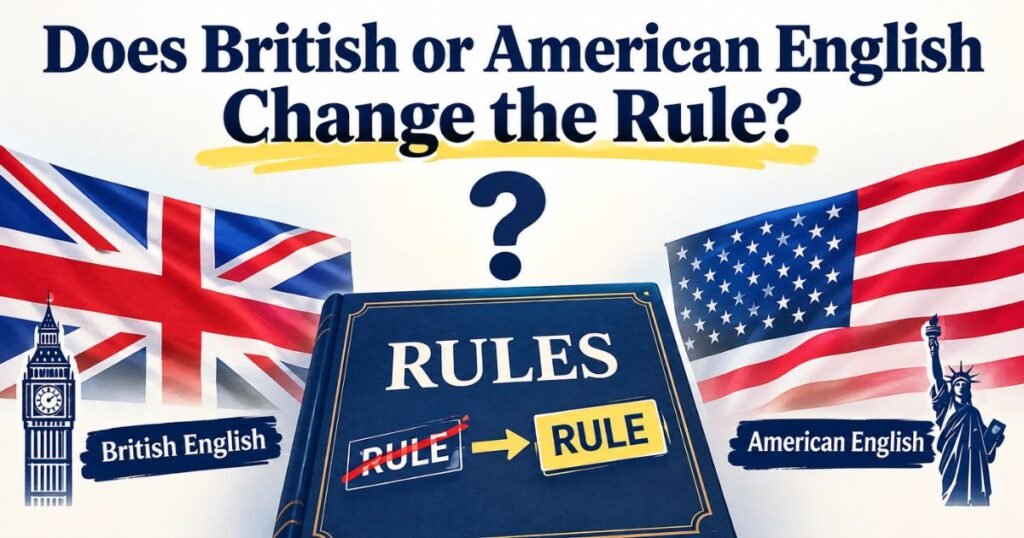
Yes, British and American English do change how this phrase is used. This is one of the clearest cases where regional English differs, even though both versions are grammatically correct.
British English speakers grew up hearing “in the street” in daily conversation. It feels completely natural to them. This comes from older English usage patterns that have stayed strong in the UK, Ireland, and some Commonwealth countries.
Also Read This: Do Not vs Don’t
American English speakers almost always use “on the street.” This became the standard through decades of media, education, and communication style in the United States. If you watch American movies or read American books, you will notice “on the street” appears far more often.
Here is a quick comparison table:
| Region | Common Phrase | Example |
| United Kingdom | in the street | “She was standing in the street.” |
| United States | on the street | “She was standing on the street.” |
| Canada | on the street | “He walked on the street.” |
| Australia | in the street (sometimes) | “They played in the street.” |
If you are writing for a British audience, “in the street” will feel more natural. If your audience is American, “on the street” is the safer and more familiar choice. For global content, many writers now lean toward “on the street” since it feels more neutral and widely understood.
Common Mistakes with Street Prepositions
Even fluent English speakers make small mistakes with prepositions. Since “in” and “on” seem similar, mixing them up is common. Here are some frequent errors and how to fix them.
Mistake 1: Mixing British and American style in one piece of writing. Writers sometimes switch between “in the street” and “on the street” without noticing. This makes the writing feel inconsistent. Stick to one style throughout your content.
Mistake 2: Using “in the street” for addresses. Saying “The bakery is in the street” sounds incorrect. The correct phrase is “The bakery is on the street” or better yet, “The bakery is on Main Street.”
Mistake 3: Overusing “street” itself instead of the actual street name. Native speakers often prefer saying the exact street name. For example, “He lives on Baker Street” sounds more natural than “He lives on the street.”
Mistake 4: Forgetting regional audience. Writers sometimes use British phrasing for American readers or vice versa. This creates unnatural sentences and confuses SEO tools targeting a specific region.
Mistake 5: Overcomplicating simple sentences. Some learners try to use fancy prepositions instead of the correct simple ones. Keeping sentences simple avoids grammar mistakes and sounds more natural.
Avoiding these small errors instantly makes your English sound more polished and professional.
How to Remember In the Street vs On the Street
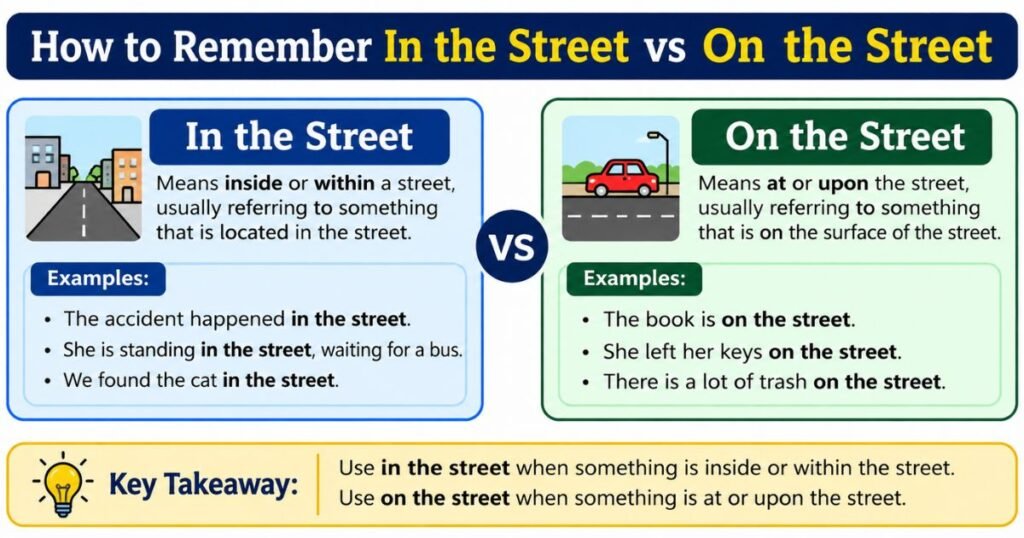
A simple memory trick can help you choose the right phrase every time. Here are easy ways to remember the difference.
- Think about British vs American English. If you are writing for UK readers, use “in the street.” If you are writing for US readers, use “on the street.”
- Ask yourself: location or action? If you are naming a place (a shop, a house, an address), always use “on the street.” If you are describing someone standing or playing there, British English prefers “in the street.”
- Picture the difference visually. “In the street” gives an image of someone standing physically inside the road area, almost surrounded by it. “On the street” gives an image of someone standing along the surface of the road, like walking on a path.
- Use “on” as your safe default. If you are unsure which one to use, “on the street” works correctly in almost every situation, especially in global or American English writing.
Here is a short summary table for quick reference:
| Rule | Use This Phrase |
| Talking about an address or shop | on the street |
| British English, describing people/objects on the road | in the street |
| American English, describing people/objects on the road | on the street |
| Unsure which one to use | on the street (safer choice) |
With practice, choosing the right phrase becomes automatic. The more you read and listen to native English content, the easier this distinction becomes.
Conclusion
The difference between “in the street” and “on the street” comes down to region and context. British English speakers often use “in the street” when describing people or objects present on the road. American English speakers almost always use “on the street” in the same situations. When referring to a location, shop, or address, “on the street” works correctly in both versions of English.
Understanding this small grammar rule helps you write and speak more naturally, whether you are a student, a content writer, or someone learning English as a second language. Once you know the context, region, and meaning behind each phrase, choosing the right one becomes simple and stress-free.

Mubeen is a passionate writer and content creator who enjoys sharing useful, engaging, and easy-to-understand information. With a focus on well-researched and reader-friendly content, Mubeen aims to help readers discover valuable insights and reliable information.