
English learners often get stuck on one small question. Should you write “do not” or “don’t”? Both are correct. Both mean the same thing. But they are not always used the same way.
This guide breaks down the difference in simple words. You will learn when to use each form, see real examples, and avoid common mistakes. By the end, you will know exactly which one fits your sentence.
The Core Rule: How Negation Works With “Do”
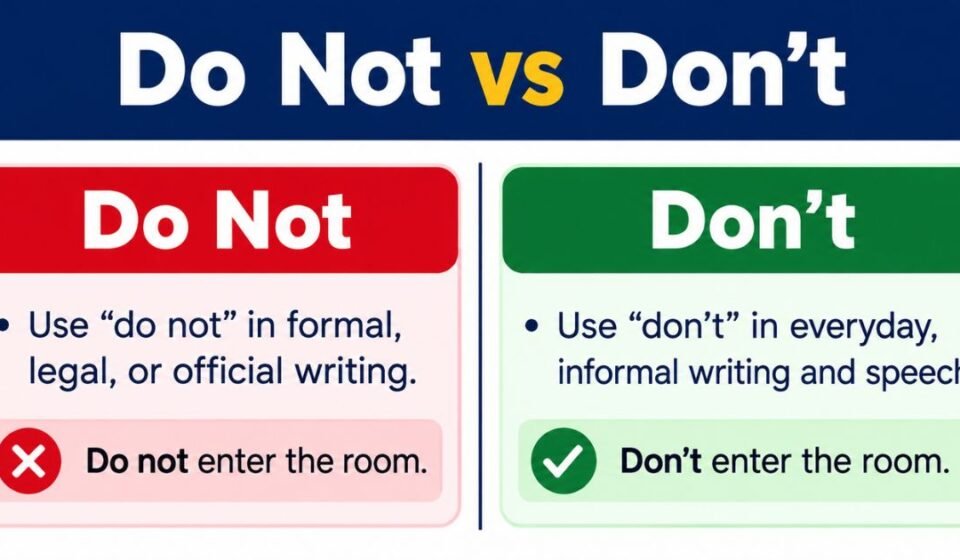
In English, we use “do” as a helping verb to build negative sentences. When we want to say something is not true, or tell someone not to do something, we usually need “do” plus “not.”
“Don’t” is simply a short form of “do not.” The apostrophe replaces the missing letters. Both forms carry the exact same meaning. The only real difference is how formal or casual the sentence sounds.
Here is a quick way to remember it:
| Form | Type | Best Used In |
| Do not | Full form | Formal writing, official notices, emphasis |
| Don’t | Contraction | Everyday speech, casual writing, friendly tone |
Now let’s look at real examples to see this rule in action.
Example 1
Do not touch the wet paint. Don’t touch the wet paint.
Both sentences warn someone about the same thing. The first sounds more serious, like a warning sign. The second sounds like something a friend might say.
Example 2
Do not forget your keys. Don’t forget your keys.
This is a common reminder. In daily conversation, “don’t” feels natural. In a formal note or email, “do not” feels more polished.
Example 3
Do not enter this room. Don’t enter this room.
Notice how “do not” fits better on a sign or in a rule book. “Don’t” fits better in a spoken warning between two people.
Example 4
Do not worry about the results. Don’t worry about the results.
Here, both sentences offer comfort. The tone changes slightly. “Don’t worry” sounds warmer and more personal.
Example 5
Do not believe everything you read online. Don’t believe everything you read online.
This advice works in both forms. Articles and essays often use “do not” for a more serious tone. Blog posts and casual writing often use “don’t.”
Example 6
Do not call me after 9 PM. Don’t call me after 9 PM.
This is a simple instruction. Text messages and casual notes almost always use “don’t.” A formal workplace memo might use “do not.”
Example 7
Do not hesitate to contact us. Don’t hesitate to contact us.
This phrase appears often in customer service emails. Companies use “do not” when they want to sound professional. They use “don’t” when they want to sound approachable.
Imperative / Prohibition
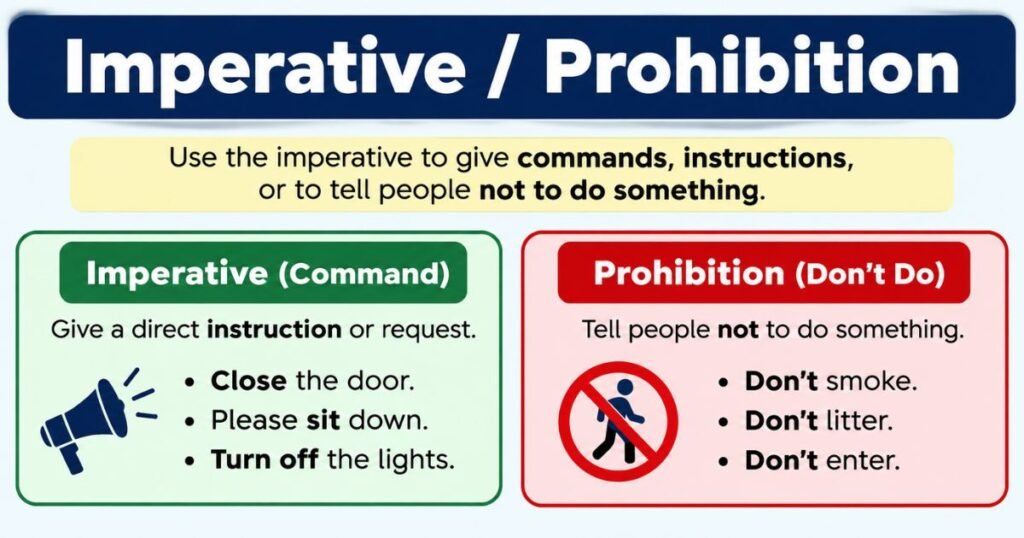
An imperative sentence gives a command or instruction. When you tell someone not to do something, you are using a negative imperative. Both “do not” and “don’t” work here, but the choice affects the tone.
Formal instructions, legal notices, and safety warnings almost always choose “do not.” This is because “do not” sounds firmer and leaves no room for casual interpretation. Signs like “Do Not Enter” or “Do Not Disturb” are strong examples.
Example 8
Do not feed the animals.
This type of sentence appears on signs at zoos, parks, and public spaces. The full form gives the instruction extra weight. It feels like a rule, not just a suggestion.
Imperative Contracted
When the same command is spoken casually, “don’t” takes over. This contracted form softens the instruction. It still tells someone what not to do, but it sounds less strict.
Example 9
Don’t feed the animals, okay?
Notice how adding “okay” at the end makes the sentence sound even more casual. This is common in spoken English between friends, family members, or coworkers who know each other well.
Here is a simple table showing how tone shifts between the two forms in commands:
| Sentence | Tone | Common Setting |
| Do not smoke here | Strict, official | Public signs, rules |
| Don’t smoke here | Friendly reminder | Conversation, casual note |
| Do not open until Christmas | Formal instruction | Packaging, labels |
| Don’t open until Christmas | Playful reminder | Gift tags, family notes |
Emphatic Negative With Auxiliary Do
Sometimes we want to stress a negative point strongly. In this case, “do not” often works better than “don’t,” especially in spoken English. When you separate the words and stress “not,” the sentence gains extra force.
This pattern is common when someone wants to correct a misunderstanding or make a firm point. Speakers often slow down and stress each word for effect.
Example 10
“I do not know what you are talking about.”
Compare this with the shorter version: “I don’t know what you are talking about.” The second one sounds like a normal answer. The first one sounds like the speaker is frustrated or wants to be taken seriously.
This emphatic style is also common in writing when an author wants to make a strong claim. For example: “We do not accept late submissions under any circumstances.” Using the full form here adds weight to the rule.
Question With Negation
Negative questions also use “do not” or “don’t,” but the contracted form is almost always used in speech and casual writing. The full form in questions can sound old-fashioned or overly formal.
For example:
- Don’t you like coffee?
- Do you not like coffee? (formal, less common)
In most everyday situations, people ask negative questions using “don’t.” This includes checking facts, expressing surprise, or making polite requests.
- Don’t you think it’s cold today?
- Don’t we need to leave soon?
- Doesn’t she work here anymore?
Note that with third-person singular subjects (he, she, it), the form changes to “doesn’t,” which is short for “does not.” The same tone rules apply here too.
Common Mistakes & Corrections
Many learners mix up “do not” and “don’t” with other negative forms, or use them incorrectly with certain subjects. Here are some frequent errors and how to fix them.
| Mistake | Correction | Why |
| She don’t like tea. | She doesn’t like tea. | Third-person singular needs “doesn’t.” |
| Do not you want to come? | Don’t you want to come? | Contracted form is standard in questions. |
| I don’t knows the answer. | I don’t know the answer. | No extra “s” after “don’t” or “do not.” |
| We doesn’t have time. | We don’t have time. | “We” takes “don’t,” not “doesn’t.” |
| He don’t care. | He doesn’t care. | Same subject-verb rule applies here. |
A few tips to avoid these errors:
- Always match “do not” or “don’t” with plural subjects (I, you, we, they).
- Always match “does not” or “doesn’t” with singular subjects (he, she, it).
- Never add an extra “s” to the main verb after “don’t” or “doesn’t.”
- Read your sentence out loud. Mistakes often sound wrong even before you check the grammar rule.
Deep Dive (One Common Error)
One of the most common errors happens with third-person singular subjects. Many learners say “He don’t know” instead of “He doesn’t know.” This mistake is so common in casual speech that some people think it sounds natural, but it is grammatically incorrect in standard English.
Also Read This: Hi There Meaning
The rule is simple. Singular subjects like “he,” “she,” and “it” need “does not” or “doesn’t.” Plural subjects like “I,” “you,” “we,” and “they” need “do not” or “don’t.” This rule does not change based on formality. It stays the same in both casual and formal writing.
Here is a clear comparison:
- Incorrect: She don’t want to go.
- Correct: She doesn’t want to go.
- Incorrect: It don’t matter.
- Correct: It doesn’t matter.
This error is common in informal spoken English, especially in some dialects and song lyrics. But in written English, especially in school, business, or professional settings, it is important to use the correct form. Getting this right instantly makes your writing sound more polished and accurate.
Nuance & Variations

Beyond the basic rule, there are smaller details that change how “do not” and “don’t” are used across different types of English and different situations.
American vs British English
Both American and British English follow the same basic grammar rule for “do not” and “don’t.” There is no major difference in how the contraction works. However, some minor style differences exist.
- British English sometimes leans slightly more formal in written business communication.
- American English tends to use contractions more freely, even in semi-formal writing like emails and articles.
- Both varieties use “do not” for signs, legal text, and strong warnings.
In everyday speech, both American and British speakers use “don’t” constantly. The difference shows up more in writing style than in grammar rules.
Formal vs Casual
The biggest factor in choosing between “do not” and “don’t” is not geography. It is formality. This single idea covers most real-world use cases.
| Situation | Recommended Form |
| Legal documents | Do not |
| Business emails | Do not (or don’t, depending on company tone) |
| Text messages | Don’t |
| Social media posts | Don’t |
| Academic essays | Do not |
| Conversations with friends | Don’t |
| Public signs | Do not |
| Blog posts (casual tone) | Don’t |
As a general rule, use “do not” when you want your writing to sound serious, professional, or official. Use “don’t” when you want your writing to sound relaxed, friendly, or conversational.
Idiomatic Expressions and Special Uses
English has many fixed phrases and idioms that use “don’t” instead of “do not.” These expressions rarely switch to the full form because they are part of everyday spoken language.
Some common examples include:
- “Don’t mention it.” (a polite reply after someone says thank you)
- “Don’t sweat it.” (meaning don’t worry)
- “Don’t get me wrong.” (used before explaining something carefully)
- “Don’t ask.” (used when something is too complicated or annoying to explain)
- “I don’t buy it.” (meaning I don’t believe it)
These idioms almost always use “don’t” because they come from casual, spoken English. Saying “Do not mention it” instead of “Don’t mention it” would sound stiff and unnatural in most everyday conversations.
On the other hand, some fixed formal phrases keep “do not” even in modern usage, such as warning labels, contracts, and instructional manuals. “Do not exceed recommended dosage” is one common example seen on medicine labels.
Practical Tips & Checklist
Here is a simple checklist to help you choose the right form every time you write or speak.
- Ask yourself: is this formal or casual? Formal leans toward “do not.” Casual leans toward “don’t.”
- Check your subject. Use “don’t” with I, you, we, they. Use “doesn’t” with he, she, it.
- For signs, rules, and legal text, always choose “do not.”
- For conversations, texts, and social posts, “don’t” almost always sounds more natural.
- If you want to stress a point strongly, try using “do not” even in casual writing. It adds weight to your message.
- Read your sentence out loud before finalizing it. If it sounds robotic, try switching forms.
- Avoid mixing formal and casual forms within the same paragraph. Keep your tone consistent.
Following this simple checklist will help your writing sound clear, correct, and appropriate for any situation.
Final Thoughts
Choosing between “do not” and “don’t” is not about right or wrong. Both are grammatically correct. The real choice comes down to tone, setting, and how strongly you want to make your point. Formal writing, signs, and serious warnings usually call for “do not.” Everyday speech, texts, and friendly notes call for “don’t.”
Once you understand this simple idea, using the right form becomes automatic. Pay attention to your subject, keep your tone consistent, and read your sentences out loud when you are unsure. With a little practice, you will never second-guess yourself again.

Mubeen is a passionate writer and content creator who enjoys sharing useful, engaging, and easy-to-understand information. With a focus on well-researched and reader-friendly content, Mubeen aims to help readers discover valuable insights and reliable information.